

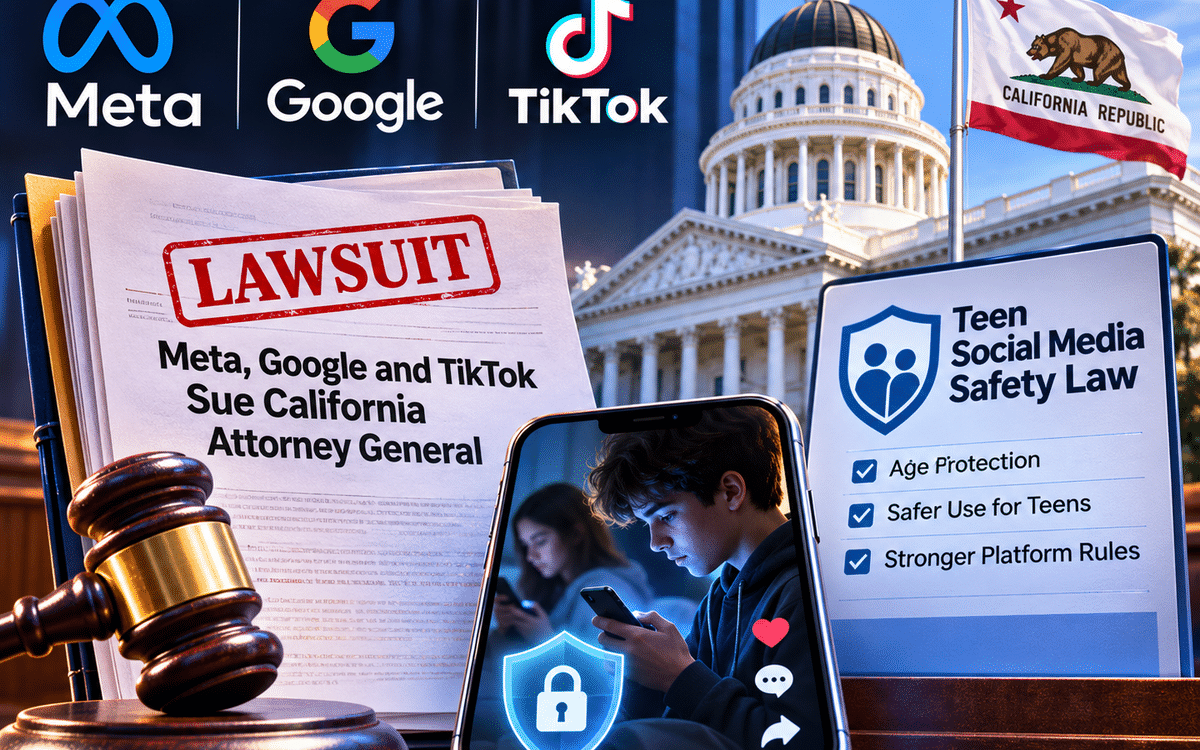
Should social media companies be allowed to recommend endless streams of videos to 14-year-olds, even when those features are designed to keep users engaged for longer?
California has introduced legislation intended to restrict that kind of experience for children under 16. Three of the world’s largest technology companies are now challenging it in court.
On 4 November 2026, Meta Platforms, Google and TikTok filed separate federal lawsuits against California Attorney General Rob Bonta.
Their objective is to prevent enforcement of Assembly Bill 1709 (AB 1709), a new law targeting social media features considered addictive or psychologically exploitative for younger users.
Signed by California Governor Gavin Newsom on 10 September 2026, the legislation is scheduled to take effect on 1 January 2027.
The companies argue that the law interferes with constitutional free speech protections, restricts their ability to organise online content and undermines decisions that should belong to parents.
California’s position is different. Its lawmakers believe stronger restrictions are necessary to protect children from online experiences designed to encourage compulsive use.
The dispute could have consequences beyond the United States, particularly as the UK strengthens its own approach to children’s online safety.
This article explains what the California teen social media law requires, why Meta, Google and TikTok are suing, what could happen next and what the legal battle means for UK families and digital businesses. Reuters+2
What Is the California Teen Social Media Law?
California Assembly Bill 1709 is legislation designed to prevent covered online platforms from providing addictive features to users under 16. It targets engagement mechanisms such as personalised feeds, endless scrolling and autoplay, while requiring reasonable age-assurance measures. The law is scheduled to take effect on 1 January 2027, subject to the ongoing legal challenges.
The legislation was introduced by Assemblymember Josh Lowenthal and other California lawmakers.
Its purpose is to address concerns about online services that encourage young users to spend prolonged periods engaging with content.
Rather than focusing only on whether a particular video or post is harmful, AB 1709 examines how platforms present content and encourage continued interaction.
This is a significant distinction.
A social media platform might host material that is appropriate for a teenager but deliver it through an interface designed to keep that user scrolling indefinitely.
California’s law seeks to regulate those design features.
Which Features Does AB 1709 Restrict?
The legislation identifies several types of potentially addictive functionality.
Personalised recommendations
Many social media platforms use algorithms to recommend content based on previous activity, preferences and engagement.
California’s legislation targets certain recommendation systems intended to prolong user engagement.
Autoplay videos
Autoplay allows another video to begin without the user actively selecting it.
Lawmakers are concerned that this can encourage extended viewing sessions.
Endless scrolling
Infinite-scroll interfaces continuously load additional content.
This removes natural stopping points that might otherwise encourage someone to finish a browsing session.
Engagement-driven notifications
Notifications can encourage users to return repeatedly to an application.
The legislation includes certain notification-related functionality within its broader definition of addictive features.
The legal definition is important: not every recommendation, notification or automated feature is necessarily covered in the same way. The precise scope depends on the enacted wording and its application. Digital Democracy+1
Does California Ban Social Media for Everyone Under 16?
Not in the same straightforward way as a universal prohibition on every social media service.
AB 1709 restricts covered platforms from providing defined addictive features to users under 16.
However, the law also contains account-related requirements that can have significant consequences for teenagers using affected services.
The technology companies argue that because certain features are central to their platforms, compliance could effectively prevent some younger users from accessing those services.
That is a contested legal argument, not an established finding that the law prohibits every form of online communication for children.
What Happened in the Meta, Google and TikTok Lawsuits?
The three companies filed separate lawsuits in federal courts in California on 4 November 2026.
Each is seeking to prevent AB 1709 from being enforced.
Although the cases are separate, their central arguments overlap.
The companies contend that California is attempting to control how online platforms select, organise and distribute content.
They also argue that the law interferes with parental decision-making.
Where Were the Lawsuits Filed?
The cases were brought in different federal court locations:
- Meta: San Francisco.
- Google: San Jose.
- TikTok: Los Angeles.
All three lawsuits name California Attorney General Rob Bonta, whose office is responsible for enforcing the legislation.
Why Is the Attorney General Being Sued?
In challenges to government legislation, companies may sue the official responsible for enforcing the disputed law.
The purpose is to obtain a court order preventing enforcement.
The lawsuits do not mean that Bonta personally created every requirement in AB 1709.
He is named in his official enforcement capacity.
What Has California Said?
The California Attorney General’s office has indicated that it is reviewing the lawsuits and intends to defend the state’s child safety legislation.
The cases therefore represent a direct legal disagreement over the limits of state regulation of online platforms. KQED+1
Why Is Meta Suing California?
Meta operates Facebook and Instagram, both of which rely on systems that organise and recommend content.
The company argues that AB 1709 interferes with decisions about how content is presented to users.
The First Amendment Argument
Meta contends that the First Amendment protects aspects of its editorial judgement.
In its view, selecting and arranging third-party content involves expressive decisions.
The company argues that California cannot simply dictate how those decisions must be made.
Whether the courts accept this argument will depend on the legal analysis of the law’s requirements and the applicable constitutional standards.
Concerns About Teen Access
Meta also argues that the legislation could require substantial changes to services used by teenagers.
It says the consequences may include removing existing features or restricting access for younger users.
The company presents this as a potential disruption to social connections and access to online communities.
Parental Choice
Meta maintains that parents should have an important role in determining how teenagers use its platforms.
California’s lawmakers, however, argue that parental controls alone may not adequately address harmful design practices.
The legal dispute concerns whether the state has exceeded its authority in imposing particular restrictions.
Why Is Google Challenging the Law?
Google’s lawsuit is particularly relevant to YouTube.
YouTube uses recommendation systems, playlists and video playback features to help users discover content.
Google argues that broad restrictions could interfere with those systems.
Recommendations Can Serve Different Purposes
A recommendation algorithm does not necessarily exist only to maximise screen time.
It may also help users find educational videos, tutorials or other relevant material.
Google argues that removing certain discovery features could make it harder to provide appropriate content to younger users.
Existing Parental Controls
Google has pointed to existing YouTube protections, including parental supervision tools and restrictions on certain features.
The company argues that parents should retain meaningful control over their children’s viewing experiences.
However, the existence of parental controls does not automatically establish that every platform design is safe.
California’s legislation takes the position that some engagement mechanisms warrant direct regulation.
Why the Outcome Matters for YouTube
A decision affecting recommendation systems could influence how platforms design feeds and video discovery features for younger audiences.
The implications could extend beyond entertainment to educational content and other services that depend on personalised recommendations. KQED
Why Is TikTok Suing California?
TikTok’s service is built around short-form videos and a highly personalised recommendation feed.
Its legal challenge therefore goes to the heart of how the platform operates.
The Role of the For You Feed
TikTok’s For You feed recommends videos according to signals associated with user interests and activity.
This system is central to how people discover content on the application.
TikTok argues that restricting personalised recommendations interferes with protected editorial activity.
Free Expression Concerns
The company maintains that content curation is a longstanding practice across different media industries.
Its argument is that the government should not be able to prohibit an entire method of presenting lawful content merely because it considers the format undesirable.
California’s response is that the legislation addresses potentially harmful design features affecting children, rather than banning particular viewpoints.
What About TikTok’s Existing Safety Measures?
TikTok has pointed to its existing protections for younger users.
However, the central legal question is not simply whether TikTok has introduced safety tools.
It is whether California may require additional restrictions and whether those restrictions comply with federal law.
What Is the First Amendment and Why Does It Matter?
The First Amendment to the US Constitution protects freedom of speech and expression against certain forms of government interference.
It is central to the lawsuits because the companies argue that selecting, recommending and organising content involves protected expression.
Is a Recommendation Algorithm Protected Speech?
This is one of the important questions raised by the cases.
Online platforms do more than store content.
They also decide which posts to display, how to rank them and what users are likely to encounter.
Technology companies argue that these activities can involve editorial judgement.
However, governments may regulate some business practices and product features without necessarily violating free speech protections.
The legal outcome depends on how a court characterises the challenged conduct and applies constitutional principles.
What Is Section 230?
Section 230 of the US Communications Decency Act provides certain protections to online platforms concerning content created by third parties.
Meta, Google and TikTok argue that aspects of California’s legislation conflict with this federal framework.
The courts will need to assess whether the state law is pre-empted by federal law and how Section 230 applies to the particular restrictions.
It would be inaccurate to assume that Section 230 automatically prevents all regulation of social media design.
Does the First Amendment Apply in the UK?
No. The US First Amendment is part of American constitutional law.
The UK has its own legal framework for freedom of expression, including protections under the Human Rights Act and the European Convention on Human Rights.
The legal tests and regulatory structures are different.
A US court ruling may influence international policy discussions, but it would not automatically determine whether a similar UK rule is lawful.
Why Does California Want Stronger Teen Social Media Protections?
California lawmakers are concerned that certain platform features encourage compulsive engagement among younger users.
The legislation reflects a broader debate about the relationship between digital design, screen time and children’s wellbeing.
Concerns About Compulsive Use
Endless scrolling, autoplay and personalised recommendations can make it easy to continue consuming content.
For teenagers, policymakers are concerned that prolonged engagement may interfere with sleep, schoolwork and other activities.
However, the effects of social media are complex.
The experiences of individual young people differ, and research findings should not be reduced to the claim that every type of social media use causes the same harm.
Children’s Development
Teenagers are still developing habits relating to attention, decision-making and self-regulation.
Supporters of the law argue that technology companies should account for these differences when designing services.
Platform Responsibility
California’s approach places greater responsibility on service providers.
Instead of expecting parents and teenagers to manage every risk themselves, it seeks to restrict certain design practices at the platform level.
The Counterargument
Critics warn that broad restrictions could remove beneficial online experiences.
Teenagers use digital platforms for learning, creative expression, friendships and community support.
A poorly designed law could restrict those opportunities without delivering proportionate safety benefits.
The central policy challenge is protecting children while preserving access to useful and lawful online services.
How Could the California Teen Social Media Law Affect Teenagers?
The practical impact of AB 1709 depends on whether it takes effect and how platforms implement its requirements.
Changes to Social Media Feeds
If the law is enforced, affected services may need to change how they recommend content to users under 16.
Teenagers could encounter less personalised feeds or different ways of selecting videos and posts.
Reduced Autoplay and Endless Scrolling
Restrictions on continuous playback and scrolling could create more natural stopping points.
However, whether these changes improve wellbeing would depend on how they work in practice and how young users respond.
Account Restrictions
Some platforms may conclude that they cannot offer compliant experiences without substantial redesign.
The law’s account-related requirements could therefore affect access to particular services.
Effects on Education and Community
Social media is not used exclusively for entertainment.
Teenagers may rely on online communities, educational creators and interest-based groups.
Policymakers need to consider whether restrictions unintentionally reduce access to beneficial resources.
Greater Attention to Age Verification
Platforms would need to distinguish users under 16 from older users.
That introduces privacy and implementation challenges, particularly where users have limited access to identification or other verification methods.
Age Verification and Teen Online Privacy: The Hidden Challenge
Age assurance is one of the most important practical questions surrounding social media regulation.
A platform cannot reliably apply age-based restrictions unless it has an appropriate method of determining which users fall within the relevant age group.
What Is Age Assurance?
Age assurance is the broader process of determining or estimating whether a user meets an age requirement.
It can involve different methods, including age estimation, age verification and age-related information supplied through supported systems.
These methods have different levels of accuracy and privacy implications.
Why Is Age Verification Controversial?
Some methods require users to provide personal information.
Depending on the system, this could involve identity documents, photographs or information from a third-party provider.
Collecting additional information creates questions about data security, retention and misuse.
Could Adults Also Be Affected?
Potentially.
If a platform cannot identify a user’s age through existing information, it may need to apply age-assurance measures more widely.
This can affect adults who want to access lawful content without sharing unnecessary personal information.
What Do Digital Rights Groups Say?
The Electronic Frontier Foundation has criticised California’s approach, arguing that broad restrictions could create serious privacy and free expression problems.
Its concerns illustrate that opposition to AB 1709 is not limited to technology companies seeking to protect their commercial interests.
Some civil liberties advocates also question whether the law is sufficiently proportionate. CalMatters+1
What Would a Privacy-Conscious Approach Look Like?
A well-designed age-assurance system should seek to establish the necessary age information without collecting more personal data than required.
It should also consider security, accessibility, accuracy, retention and the ability to challenge incorrect age assessments.
These principles are relevant to both American and British online safety policy.
Could Companies Face Penalties for Breaking AB 1709?
The legislation includes enforcement provisions for covered platforms.
Reporting on the enacted law indicates that penalties could reach $50,000 per affected user under 16, depending on the relevant violation and enforcement circumstances.
This is a potential statutory exposure, not an amount that has already been imposed on Meta, Google or TikTok under the new law.
The scale of possible penalties helps explain why the companies are seeking judicial intervention before the scheduled commencement date. TechCrunch
How Does the California Law Compare with the UK’s Online Safety Act?
The UK has its own legal framework for protecting children online.
The Online Safety Act 2023 places duties on in-scope online services, including social media platforms and search services.
Its approach is not identical to California’s AB 1709.
The UK Focuses on Platform Safety Duties
The Online Safety Act requires covered services to assess and address risks relating to illegal content and content harmful to children.
Depending on the service and applicable requirements, providers may need to implement measures concerning content moderation, recommendation systems, age assurance and user protection.
The legislation creates a broader regulatory framework rather than simply restricting one category of social media feature.
Ofcom Oversees Compliance
The UK’s communications regulator, Ofcom, oversees the online safety regime.
It publishes codes of practice and guidance to help providers understand their duties.
Serious non-compliance can lead to substantial penalties.
The UK Also Uses Age Assurance
Ofcom’s guidance addresses highly effective age assurance for services where it is required.
The regulator recognises that age assurance must be effective while also complying with privacy and data protection obligations.
The precise requirements depend on the service and the risks involved. www.ofcom.org.uk+1
Is the UK Planning a Social Media Ban for Under-16s?
The UK government has announced plans to strengthen age restrictions on social media.
According to Ofcom’s guidance updated in October 2026, the government announced measures in June 2026 intended to prevent under-16s from using social media services and to restrict certain other online features.
Ofcom states that the government intends to lay the first related regulations before Parliament by the end of 2026.
These proposed additional restrictions should not be confused with requirements that are already fully in force.
The existing Online Safety Act duties continue to apply while further measures are developed. www.ofcom.org.uk
Why the California Case Matters to Britain
The American lawsuits raise questions that are also relevant to UK policymakers.
Can governments restrict particular engagement features without unnecessarily limiting access to lawful information?
How should platforms establish users’ ages?
What role should parents have?
And how can regulators measure whether restrictions genuinely improve children’s safety?
Although UK courts would apply different laws, the practical and policy questions overlap.
What Does This Mean for UK Digital Marketing Agencies and Businesses?
The California dispute is particularly relevant to businesses that rely on social media to communicate with customers.
However, UK organisations should not treat AB 1709 as a law that directly governs all of their domestic marketing activities.
Its immediate legal scope concerns California.
Social Media Campaigns May Need to Adapt
If platforms change recommendation systems or age-related features, businesses may experience changes in how content reaches younger audiences.
This could affect organic visibility, video discovery and campaign planning.
However, no particular algorithm change should be assumed before the legal and product outcomes are known.
Age-Appropriate Marketing Matters
Businesses whose products or content appeal to teenagers should pay particular attention to age-appropriate advertising practices.
Marketing should not exploit children’s vulnerabilities or encourage inappropriate purchasing behaviour.
In the UK, advertising rules and data protection requirements may impose additional obligations depending on the circumstances.
Avoid Overdependence on One Platform
Businesses that rely entirely on a single social media channel are exposed to changes in platform policies, recommendation systems and regulation.
A more resilient digital strategy may include a well-maintained website, relevant search visibility and several appropriate communication channels.
Review Data Collection Practices
Where businesses collect information from younger users, they should consider the applicable data protection requirements.
The UK Information Commissioner’s Office provides guidance on children’s personal information and age-appropriate design.
Focus on Meaningful Engagement
Regulatory developments reinforce the value of content that is useful rather than deliberately manipulative.
Businesses can build trust through accurate information, clear communication and accessible digital experiences.
What Should Parents and Educators Take from the Lawsuit?
The legal dispute may take time to resolve.
Families and schools do not need to wait for a court decision before discussing safer online habits.
Understand How Recommendation Systems Work
Teenagers benefit from understanding why platforms suggest particular videos and posts.
Recommendations are influenced by design choices and user activity.
They are not necessarily neutral assessments of what is best for the viewer.
Explore Existing Safety Settings
Many platforms provide tools for managing privacy, notifications, screen time and interactions.
The available controls differ between services and may change.
Parents and educators should consult official platform guidance rather than assuming that every application offers the same protections.
Discuss Online Experiences
Open conversations can help young people identify uncomfortable interactions, misleading content and unhealthy usage patterns.
Safety discussions are more useful when teenagers can raise concerns without assuming they will automatically lose access to their devices.
Consider the Benefits as Well as the Risks
Online platforms can provide educational resources, friendships and creative opportunities.
A balanced approach recognises those benefits while addressing potential harms.
Know Where to Seek Help
UK families can access online safety information through organisations such as the NSPCC and Childnet.
Serious concerns involving exploitation, threats or criminal behaviour should be reported through appropriate official channels.
What Could Happen Next in the California Lawsuits?
The lawsuits are at an early stage.
The companies are seeking court intervention before AB 1709 is scheduled to take effect on 1 January 2027.
Several outcomes are possible.
A Court Could Temporarily Block Enforcement
The companies may seek preliminary injunctions preventing enforcement while the legal challenges continue.
Such an order would not necessarily represent a final decision on the law’s constitutionality.
The Law Could Take Effect
If the courts do not block the legislation, covered platforms may need to comply with its applicable requirements from the commencement date.
Some Provisions Could Be Challenged Successfully
A court might find that particular requirements are unlawful without necessarily invalidating the entire legislative scheme.
The outcome would depend on the court’s reasoning and the law’s severability provisions.
Appeals Could Extend the Dispute
Any significant ruling could be appealed.
That means the final legal position may take longer to establish than the initial 2027 commencement date suggests.
California Could Amend Its Approach
Legislators may respond to judicial findings or practical implementation problems through further legislation.
However, no particular amendment should be assumed.
As of 7 November 2026, the filing of these lawsuits does not itself mean that AB 1709 has been struck down.
The Wider Future of Social Media Regulation for Teenagers
California’s legal battle reflects a broader international debate about children’s digital experiences.
Governments are increasingly questioning whether existing platform safeguards are sufficient.
Technology companies, meanwhile, argue that broad restrictions can interfere with lawful expression and the tools used to provide relevant content.
Regulation Is Moving Beyond Harmful Posts
Traditional content moderation focuses on what users can see.
Newer legislation increasingly examines how services are designed.
This includes recommendations, notifications, scrolling mechanisms and other engagement features.
Privacy Will Remain Central
Age-based restrictions require effective ways to distinguish younger users from adults.
Policymakers will need to balance accuracy with privacy, accessibility and data minimisation.
Platform Design Could Change
Future regulation may encourage services to introduce clearer stopping points, more age-appropriate defaults and stronger user controls.
However, the effectiveness of these measures should be assessed through evidence rather than assumptions.
International Rules May Differ
Companies operating globally must account for different national laws.
A feature that is permitted in one market may be restricted in another.
This creates operational challenges for platforms and uncertainty for businesses that depend on them.
Evidence Will Matter
The long-term success of child safety regulation should be judged by whether it reduces harm while preserving access to beneficial online experiences.
Neither stronger regulation nor existing industry safeguards should be treated as automatically sufficient without evidence.
Conclusion: Why the California Teen Social Media Law Matters
The California teen social media law has become the centre of a major legal dispute between state regulators and three of the world’s largest technology companies.
Meta, Google and TikTok are challenging Assembly Bill 1709 because they argue that restrictions on personalised recommendations, autoplay and other engagement features interfere with constitutional rights and parental decision-making.
California maintains that stronger protections are necessary to address potentially harmful platform design practices affecting children under 16.
The lawsuits will test how far American states can go when regulating the design of online services.
For UK readers, the case is relevant because Britain is also strengthening online child safety protections through the Online Safety Act and proposed additional age restrictions.
For businesses and digital marketers, the wider message is that social media platforms are operating in an increasingly demanding regulatory environment.
For families, the debate reinforces the importance of privacy, age-appropriate design and informed online habits.
The central challenge is not choosing between children’s safety and digital freedom. It is developing proportionate rules that protect young users without unnecessarily restricting lawful communication, education and access to online communities.
10. FAQ Section
What is the California teen social media law?
California Assembly Bill 1709 is legislation intended to restrict covered social media platforms from providing addictive features, including certain personalised recommendations, endless scrolling and autoplay, to users under 16.
Why are Meta, Google and TikTok suing California?
The companies argue that the law violates First Amendment protections, conflicts with Section 230 of federal law and interferes with their ability to organise content and provide parental controls.
When does California AB 1709 take effect?
The law is scheduled to take effect on 1 January 2027, unless a court intervenes or the legal position changes.
Does California ban social media for children under 16?
AB 1709 is focused on covered platforms and addictive features, but its account restrictions may significantly affect access. It should not be described as an unconditional ban on every online service for all children.
Who is California Attorney General Rob Bonta?
Rob Bonta is California’s Attorney General. His office is responsible for enforcing relevant state laws, which is why he is named as the defendant in the lawsuits.
Can social media companies win these lawsuits?
They could obtain temporary or permanent relief if the courts accept their legal arguments. However, the filing of a lawsuit does not establish that the legislation is unconstitutional.
Does California’s law apply to the UK?
No. California’s law does not automatically apply to UK users or businesses. The UK has its own framework, including the Online Safety Act and relevant data protection requirements.
Is the UK banning social media for under-16s?
The UK government has announced plans for additional age restrictions. As of 7 November 2026, the proposed measures should be distinguished from existing Online Safety Act duties that already apply to covered services.

Build a Responsible and Effective Social Media Strategy
The legal challenges surrounding California’s teen social media law highlight how quickly platform rules, audience protections and digital marketing expectations can change.
For businesses, maintaining a strong online presence means more than following the latest algorithm. It requires useful content, clear communication and digital experiences that respect users.
At CRAZILS, we support UK businesses and international clients through Social Media Management, Digital Marketing, SEO, Web Design & Development, UI/UX Design, Content Creation & Marketing and Website Maintenance & Support.
Whether you want to improve your social media presence, strengthen your website or develop a more sustainable digital marketing strategy, we can help you explore practical solutions aligned with your business goals.
Contact CRAZILS to discuss your digital project.
Website: https://crazils.com
Email: info@crazils.com
Phone / WhatsApp: +44 7897 053081
CRAZILS — Digital Solutions. Real Growth.
Related News

How to Speed Up a Slow Windows Laptop Without Buying New Hardware