








- Your cart is empty Browse Shop
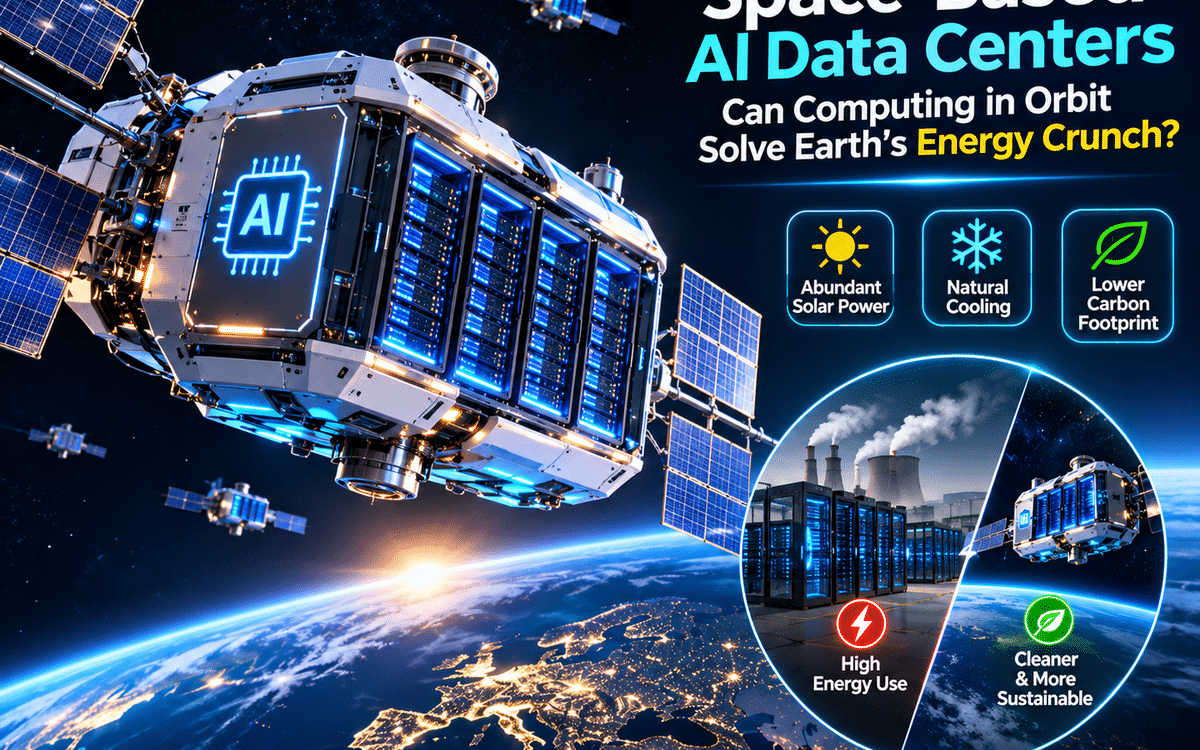
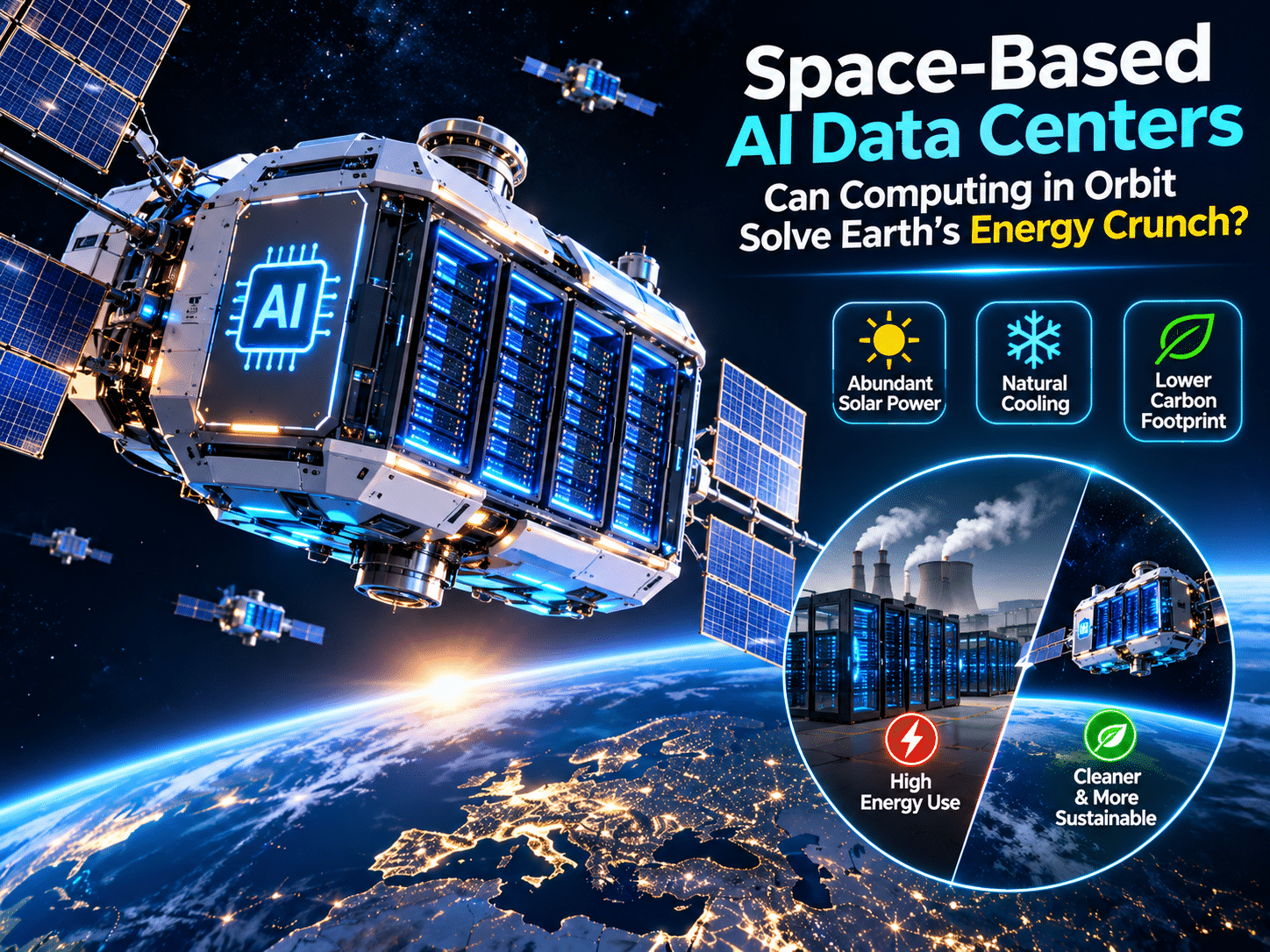
What if some of the world’s most demanding AI computations could take place hundreds of kilometres above Earth, powered by sunlight rather than electricity from terrestrial grids?
The idea sounds futuristic, but it is no longer purely theoretical.
In October 2026, Google reported successfully running early AI workloads on a prototype satellite carrying one of its Tensor Processing Units. Axiom Space has also deployed orbital computing nodes intended to support data processing and communications in space.
These developments are drawing attention to space-based AI data centers as a possible long-term response to rising electricity demand from artificial intelligence.
The challenge on Earth is substantial.
According to the International Energy Agency (IEA), data centres consumed approximately 485 terawatt-hours of electricity in 2025. Its April 2026 analysis projects consumption reaching around 950 terawatt-hours by 2030, with AI-focused facilities growing particularly quickly. IEA+1
Moving some computing into orbit could eventually reduce demand on terrestrial electricity networks. However, space introduces major engineering and commercial difficulties, including launch costs, radiation, cooling, communications and hardware replacement.
The question is not simply whether computers can operate in space. They already do.
It is whether orbital computing can become sufficiently powerful, reliable and economical to compete with the data centres that support modern AI.
What Are Space-Based AI Data Centers?
Space-based AI data centers are proposed or experimental computing facilities located on satellites or other orbital platforms. They use onboard processors, solar power, communications equipment and thermal-control systems to process information beyond Earth’s atmosphere. Their potential applications include satellite data analysis, AI inference and, eventually, larger-scale computing workloads.
The concept covers several different approaches.
A small satellite carrying an AI processor is very different from a future constellation containing thousands of interconnected computing units.
Both may be described as orbital computing, but their capabilities and economic requirements are not equivalent.
Orbital Edge Computing
Edge computing involves processing information close to where it is generated.
For example, an Earth observation satellite could analyse images in orbit rather than transmitting every raw image to the ground.
This can reduce communication requirements and help deliver useful information more quickly.
Space-Based Cloud Computing
A space-based cloud system would provide computing or storage services to spacecraft and potentially users on Earth.
Its commercial value would depend on processing capacity, network connectivity, reliability and cost.
Large-Scale Orbital AI Infrastructure
The most ambitious proposals involve interconnected satellites operating as a distributed computing network.
Such systems could theoretically support substantial AI workloads using solar energy collected in orbit.
However, the feasibility of scaling these systems to compete with terrestrial hyperscale data centres remains unproven.
Why Is Earth’s AI Computing Energy Demand Growing?
Artificial intelligence relies on electricity-intensive computing hardware.
Training advanced models can involve large clusters of specialised processors. Operating those models for users also requires continuous computing resources.
As AI adoption grows, data centres need more equipment, power and cooling capacity.
The Scale of the Energy Challenge
The IEA’s updated 2026 research estimates that global data centre electricity consumption reached approximately 485 TWh in 2025.
Its central projection puts consumption at around 950 TWh by 2030, representing approximately 3% of global electricity demand.
Electricity consumption from AI-focused data centres is expected to grow faster than the sector overall.
These are projections, not guaranteed outcomes. Demand will depend on investment, hardware efficiency, AI adoption and infrastructure constraints. IEA
Electricity Grid Constraints
A data centre cannot operate without a dependable electricity connection.
Large AI facilities may require extensive upgrades to transmission networks, substations and supporting infrastructure.
The IEA has warned that shortages of grid equipment and lengthy connection processes can delay planned projects.
Cooling Requirements
High-performance processors generate substantial heat.
Terrestrial data centres use air cooling, liquid cooling and other thermal-management systems to maintain safe operating temperatures.
Cooling adds to infrastructure complexity and can increase electricity or water requirements.
Concentrated Local Demand
Data centres account for a relatively modest proportion of global electricity consumption, but their effects can be much more significant in particular regions.
Large facilities may be concentrated around established technology hubs where electricity networks are already under pressure.
This helps explain why companies are exploring alternative locations, energy sources and computing architectures.
How Would AI Data Centers in Space Work?
A functioning orbital data centre would require more than a powerful processor attached to a satellite.
It would need several tightly integrated systems.
Solar Power Generation
Solar panels would convert sunlight into electricity.
Certain orbital configurations can provide longer periods of sunlight than terrestrial solar installations.
However, power availability depends on orbit, spacecraft orientation, eclipses and equipment performance.
High-Performance Processors
Specialised processors would perform AI calculations.
These might include accelerators designed for inference, machine learning or other demanding workloads.
Hardware must withstand the conditions encountered during launch and operation in space.
High-Speed Communications
Computing systems need to receive data and return results.
Orbital infrastructure could use radio-frequency communications, optical links between satellites and connections to ground stations.
The available bandwidth would influence which workloads are commercially practical.
Thermal Management
Processors produce heat, and that heat must be removed.
In space, thermal systems typically rely on conduction within the spacecraft and radiation from external surfaces.
Distributed Computing
Multiple satellites could theoretically work together.
However, dividing large computing workloads across moving spacecraft requires reliable communications, synchronisation and sophisticated software.
The technical difficulty increases when applications need rapid communication between processors.
Why Could Solar Power Make Space-Based Computing Attractive?
Solar energy is one of the main reasons researchers are investigating orbital AI infrastructure.
More Direct Access to Sunlight
Above Earth’s atmosphere, solar panels avoid atmospheric losses and weather-related interruptions.
Google’s Project Suncatcher research suggests that solar panels in suitable orbits could be substantially more productive than comparable installations on Earth.
Google has discussed potential productivity of up to eight times terrestrial levels under particular orbital conditions.
That figure is a research estimate associated with a specific concept, not a universal performance guarantee for every satellite. blog.google+1
Reduced Dependence on Terrestrial Grids
An orbital computing platform powered by its own solar arrays would not require the same direct electricity connection as an Earth-based data centre.
This could reduce some pressure on terrestrial electricity infrastructure.
However, launch operations, satellite manufacturing, ground stations and other supporting activities would still consume energy on Earth.
Potentially Continuous Operation
Carefully selected orbits can provide extended sunlight exposure.
That could reduce some energy-storage requirements.
Nevertheless, satellites may still experience eclipses, power fluctuations and equipment limitations.
The Importance of System-Level Efficiency
The relevant comparison is not simply how much sunlight reaches a solar panel.
Developers must consider the total usable computing delivered over a system’s lifetime.
A satellite producing abundant electricity would offer limited commercial value if its processors, communications or cooling systems could not use that power efficiently.
Google’s Project Suncatcher: AI Computing in Orbit
One of the most prominent developments is Project Suncatcher.
Google announced the project in November 2025 as a long-term research initiative investigating whether interconnected satellites could support scalable machine learning infrastructure.
The concept involves solar-powered spacecraft equipped with Google’s Tensor Processing Units and high-speed optical communications.
What Has Google Achieved?
On 1 October 2026, Google launched a prototype satellite for Project Suncatcher.
On 30 October 2026, the company reported successfully generating an AI response using a data-centre-class TPU operating in orbit.
The test involved sending a prompt from Earth to an onboard language model and receiving a generated response during a ground-station communication window.
Google described the achievement as an important early milestone. blog.google
Why Is This Significant?
The experiment demonstrated that the hardware could operate sufficiently well in orbit to complete an early AI inference task.
It also provided an opportunity to investigate processor behaviour under actual space conditions.
However, generating a short response is not equivalent to operating a large commercial AI data centre.
What Happens Next?
Google has identified further testing involving thermal stress, radiation exposure and interconnected satellites.
The company has discussed a milestone involving two linked satellites in 2027.
These experiments are intended to investigate the engineering requirements for larger orbital computing systems.
Does Project Suncatcher Prove Space-Based AI Is Commercially Viable?
Not yet.
It establishes progress towards technical feasibility.
Commercial viability would require evidence about sustained performance, launch and replacement costs, network capacity, reliability and total lifetime operating expenses.
Axiom Space and the Development of Orbital Data Centres
Google is not the only organisation exploring computing beyond Earth.
Axiom Space has been developing orbital computing infrastructure intended to support applications such as data processing, AI workloads and secure communications.
Computing on the International Space Station
Axiom Space deployed a prototype computing unit to the International Space Station in 2025.
The system was intended to demonstrate data processing and related capabilities in orbit.
Orbital Nodes Launched in January 2026
Axiom reports that its first two dedicated orbital data centre nodes launched on 11 January 2026.
The nodes were developed in connection with Kepler Communications’ optical relay network.
The approach focuses partly on providing computing and data services directly to spacecraft rather than sending every workload to Earth. axiomspace.com
Progress Reported in October 2026
On 6 October 2026, Axiom reported operating two orbital computing nodes and demonstrating communications between orbital nodes and the ground.
It also described ground-based testing involving post-quantum cryptography and workload migration.
These are early infrastructure milestones, not evidence of a fully operational orbital hyperscale data centre. axiomspace.com
Why Axiom’s Approach Matters
Axiom’s work highlights a potentially practical initial market: processing information for satellites and other spacecraft.
Computing close to the source of data may reduce the need to transmit large volumes of raw information to Earth.
That use case may become commercially viable before the much more ambitious goal of moving general-purpose terrestrial cloud computing into orbit.
Can Space-Based AI Data Centers Solve the Cooling Problem?
Cooling is one of the most misunderstood aspects of orbital computing.
Space is extremely cold in many respects, but that does not mean hot computer processors can be cooled simply by exposing them to a vacuum.
Why Cooling Is Difficult in Space
On Earth, data centres can transfer heat to circulating air or liquids and ultimately release it into the surrounding environment.
In the vacuum of space, there is effectively no surrounding air to carry heat away through convection.
Instead, spacecraft must move heat internally and release it through thermal radiation.
The Role of Radiators
Radiators are surfaces designed to emit thermal energy.
A space-based data centre would need sufficient radiator capacity to remove heat generated by processors and other equipment.
High-performance AI chips can produce considerable heat, making radiator size and mass important design constraints.
Why Sunlight Creates a Trade-Off
Solar panels benefit from exposure to sunlight.
Thermal radiators, however, need to reject heat efficiently and avoid unnecessary external heating.
Designers must therefore balance power generation, spacecraft orientation and thermal management.
Could Space Cooling Be More Efficient?
It is possible that particular orbital designs could provide advantages.
However, the absence of atmospheric convection means cooling cannot be assumed to be easier or cheaper than on Earth.
A credible economic comparison must include radiator mass, thermal hardware, launch costs and long-term reliability.
What Are the Biggest Engineering Challenges?
Moving computing infrastructure into orbit introduces difficulties that terrestrial operators rarely encounter.
Launch Costs
Every processor, solar panel, radiator and supporting component must be transported into space.
Launch costs have fallen over time, but deploying large quantities of heavy infrastructure remains expensive.
Radiation Exposure
Spacecraft are exposed to radiation that can interfere with electronic components.
High-performance processors may require shielding, error correction and other protective measures.
Google’s Project Suncatcher is investigating how its hardware performs under these conditions.
Hardware Reliability
A failed server in a terrestrial data centre can often be repaired or replaced.
In orbit, maintenance is considerably more complicated.
Developers must account for failures, redundancy and replacement missions.
Spacecraft Lifetime
Solar panels, batteries, processors and other components degrade.
The useful life of a satellite affects how frequently replacement hardware must be launched.
Orbital Debris
More satellites increase the importance of collision avoidance and responsible end-of-life disposal.
Communications
Large AI workloads can require substantial movement of data between processors.
Maintaining suitable bandwidth and latency across a satellite network is a demanding engineering problem.
Can Orbital Data Centres Deliver Fast Internet and Cloud Services?
The answer depends on the workload and network architecture.
Latency
Signals travelling between Earth and low Earth orbit experience propagation delay.
Additional delays arise from routing, network equipment, ground-station availability and processing.
Some services may tolerate these delays.
Others, such as highly interactive applications, may be more sensitive.
Bandwidth
AI workloads can involve large datasets.
Transmitting information to and from orbit requires sufficient communications capacity.
If moving the data costs more time or money than processing it, the orbital approach may offer little advantage.
Inter-Satellite Links
Optical links could help spacecraft exchange data at high speeds.
However, maintaining reliable connections between moving satellites introduces engineering challenges.
Data Locality
Some workloads are better suited to orbital computing because their data originates in space.
For example, a satellite analysing its own observations may avoid transmitting unnecessary raw information to Earth.
By contrast, moving large volumes of business data from terrestrial servers into orbit may introduce avoidable complexity.
Which AI Workloads Are Best Suited to Space?
Not every computing task has the same requirements.
Satellite Image Analysis
Earth observation satellites collect substantial amounts of imagery.
Onboard AI could identify useful features and transmit selected results.
Spacecraft Monitoring
AI systems may help analyse spacecraft telemetry and identify unusual operating conditions.
Communications Network Management
Orbital computing could assist with managing satellite communications and routing information.
Scientific Data Processing
Space-based instruments may benefit from processing information close to the source.
AI Inference
Some AI inference workloads could operate in orbit, particularly when the input data is already available there.
Large-Scale AI Training
Training advanced AI models often requires extensive communication between processors.
This makes distributed orbital training a particularly demanding challenge.
Future technology may reduce these difficulties, but large-scale orbital AI training should not be treated as an established commercial capability.
Are Space-Based AI Data Centers Environmentally Sustainable?
The sustainability argument is attractive, but it requires a complete environmental assessment.
Potential Benefits
Orbital solar power could reduce the need for terrestrial electricity generation for certain computing workloads.
Space-based processing may also reduce the amount of data that satellites need to transmit to Earth.
Launch Emissions
Rocket launches produce emissions and can affect the atmosphere.
Their environmental impact depends on propulsion technology, launch frequency and other factors.
Manufacturing Footprint
Satellites require processors, metals, solar panels and specialised components.
Producing this equipment consumes energy and materials.
Replacement and Disposal
Satellites have limited operational lifetimes.
Frequent replacement would increase manufacturing and launch requirements.
End-of-life disposal also matters.
Space Debris and Orbital Sustainability
An expanding orbital computing industry could increase congestion in popular orbital regions.
Responsible operation would require collision avoidance, tracking and disposal strategies.
The Need for Lifecycle Assessment
A credible sustainability comparison should examine emissions and resource use across manufacturing, launch, operation and disposal.
It should then compare the results with equivalent terrestrial computing capacity.
Solar-powered computing in space is not automatically carbon-neutral or environmentally superior to an efficient data centre on Earth.
Space-Based vs Earth-Based Data Centres: Which Is Better?
The answer depends on the application.
Electricity Supply
Terrestrial data centres rely on electricity networks or dedicated generation.
Orbital systems could use solar power collected directly in space.
However, both approaches require substantial infrastructure.
Cooling
Earth-based facilities have access to established cooling technologies.
Orbital facilities must reject heat through radiation, creating different design constraints.
Maintenance
Terrestrial systems can generally be serviced more easily.
Orbital hardware is harder and more expensive to repair.
Connectivity
Earth-based data centres benefit from extensive fibre networks and proximity to customers.
Orbital systems depend on space communications and ground infrastructure.
Scalability
Terrestrial data centres already operate at enormous scale.
Orbital computing is still at an early stage, with limited deployed processing capacity.
Best-Fit Applications
Earth-based infrastructure currently offers the established choice for most commercial cloud and AI workloads.
Orbital computing may offer advantages for specialised space applications and, potentially, other workloads as technology improves.
What Would Make Orbital AI Computing Commercially Viable?
Commercial success requires more than demonstrating that a processor works in space.
Lower Launch and Deployment Costs
The cost of delivering computing hardware into orbit must become competitive with the value of the services it provides.
Longer Hardware Lifetimes
Reliable systems that operate for extended periods can spread their initial costs over more useful computing work.
Efficient Thermal Management
Radiator mass and cooling performance influence both launch requirements and operational capacity.
High-Performance Communications
Networks must support the data volumes and response times required by customers.
Competitive Computing Costs
Operators need to understand the total cost per useful computing task.
This includes launch, spacecraft manufacturing, operations, replacement and communications.
Clear Customer Demand
A viable business model requires customers willing to pay for orbital computing services.
Specialised satellite processing may offer an earlier market than general-purpose AI services for terrestrial users.
What Does Space-Based AI Computing Mean for the UK?
The United Kingdom has interests in both AI infrastructure and the space economy.
Orbital computing brings these areas together, but the country’s opportunities may differ from those of organisations developing enormous satellite constellations.
The UK Space Agency’s AI Roadmap
On 27 October 2026, the UK published an Artificial Intelligence Roadmap for Space, outlining priorities for 2026–2036.
The roadmap identifies opportunities in AI assurance, Earth observation analytics, autonomous spacecraft operations, efficient computing and trusted space data infrastructure.
It also recognises that the UK is unlikely to compete with the largest international operators purely on hyperscale computing capacity.
Instead, it highlights opportunities in trusted, certifiable and resource-efficient AI systems. GOV.UK
Opportunities for British Technology Companies
UK businesses may find opportunities in specialist software, satellite data processing, AI assurance, secure communications and supporting technologies.
However, these opportunities should not be confused with a guaranteed market for commercial orbital data centres.
Research and Engineering
Universities and technology organisations can contribute expertise in spacecraft systems, machine learning, communications and thermal engineering.
Sustainability and Regulation
UK organisations may also contribute to environmental assessment, responsible space operations and technical standards.
Implications for Ordinary UK Businesses
Most UK SMEs do not need to plan for orbital cloud hosting.
Their immediate priorities remain reliable digital infrastructure, appropriate data protection, efficient software and technology investments that deliver measurable value.
Space-based computing is an important emerging field, but it is not currently a practical replacement for conventional website hosting or everyday business cloud services.
Could Orbital Data Centres Reduce Pressure on UK Electricity Grids?
In principle, moving some computing workloads into space could reduce electricity demand from terrestrial data centres.
However, the scale of any benefit would depend on how much computing actually moved into orbit.
The Scale Problem
Today’s orbital computing demonstrations involve relatively small amounts of hardware compared with terrestrial hyperscale facilities.
Meaningful reductions in grid demand would require much larger deployments.
Workload Suitability
Not all AI tasks are appropriate for orbital processing.
Tasks involving extensive terrestrial data transfer or strict latency requirements may remain better suited to Earth-based facilities.
Energy Savings Must Be Measured Properly
A comparison should account for electricity consumption, hardware manufacturing, launches, communications and replacement.
Simply shifting electricity use away from a terrestrial grid does not establish an overall environmental benefit.
Terrestrial Improvements Will Continue
While orbital computing develops, Earth-based data centres are also becoming more efficient.
Hardware improvements, cooling technology, renewable electricity and better infrastructure planning may reduce some of the pressures associated with AI expansion.
The IEA’s 2026 research identifies energy efficiency and infrastructure investment as important responses to growing demand. IEA
What Are the Security and Regulatory Challenges?
Space-based computing introduces questions about security, legal responsibility and international coordination.
Cybersecurity
Orbital computing platforms require secure communications, authentication, software updates and protection against unauthorised access.
Their remote location does not make them immune to cyber threats.
Data Protection
UK businesses processing personal data must consider applicable data protection law.
Using an orbital computing service would not automatically remove obligations under the UK GDPR.
Organisations would need to understand the provider’s arrangements, processing locations, access controls and relevant international transfer considerations.
Space Regulation
Satellite operators may require licences and must comply with applicable national and international requirements.
Collision Avoidance
Operators need appropriate measures to reduce collision risks and manage spacecraft at the end of their useful lives.
International Cooperation
Orbital infrastructure operates in an environment shared by many countries and commercial organisations.
Coordination is important for communications, space traffic management and responsible operations.
What Could Happen Over the Next Decade?
Several developments will determine whether space-based AI infrastructure becomes commercially significant.
More Demonstration Missions
Projects such as Google’s Suncatcher are expected to generate further information about hardware reliability and orbital communications.
Growth in Satellite Edge Computing
Processing data directly on spacecraft may become more common.
This offers a relatively clear use case because the data is already generated in orbit.
Improved Space Communications
Advances in optical links could support larger distributed computing networks.
More Efficient AI Hardware
Processors that deliver more computing per watt may make orbital systems more practical.
However, efficiency improvements also benefit terrestrial data centres.
Commercial Partnerships
Space companies, semiconductor manufacturers and cloud providers may explore joint projects.
Their long-term success will depend on customer demand and economics.
Continued Engineering Uncertainty
Radiation, cooling, launch expenses, reliability and communications remain major obstacles.
A successful demonstration mission should not be mistaken for proof that the entire commercial model is viable.
Conclusion: Can Space-Based AI Data Centers Solve Earth’s Computing Crunch?
Space-based AI data centers are moving from speculative concepts towards early experimental systems.
Google’s Project Suncatcher has demonstrated AI inference using a processor in orbit, while Axiom Space has deployed computing nodes designed for space-based data processing.
These developments are important, particularly as the IEA expects global data centre electricity demand to increase substantially by 2030.
Orbital solar power could eventually support some computing workloads without drawing electricity directly from terrestrial grids.
However, the technology faces significant challenges involving cooling, radiation, launch costs, communications and maintenance.
There is also no established evidence that large-scale orbital computing is currently more economical or environmentally sustainable than well-designed terrestrial infrastructure.
For the UK, the most promising near-term opportunities may involve satellite data processing, efficient AI systems, secure communications and specialist space technologies.
Space-based computing could become an important part of the future AI infrastructure landscape, but it is more likely to complement Earth’s data centres than replace them in the foreseeable future.
10. FAQ Section
What are space-based AI data centers?
Space-based AI data centres are computing systems installed on satellites or orbital platforms. They use onboard processors, communications systems and power sources, typically solar panels, to perform data processing and potentially AI workloads beyond Earth’s atmosphere.
Are there already AI data centres in space?
There are early orbital computing demonstrations. Google reported running AI inference on a satellite in October 2026, while Axiom Space has deployed orbital computing nodes. These are not equivalent to large commercial hyperscale data centres.
Can AI data centres in space run entirely on solar power?
Solar power is a leading proposed energy source, particularly in orbits offering extended sunlight exposure. However, actual power requirements, storage needs and operational reliability depend on the spacecraft design.
Is cooling easier in space?
Not necessarily. Although space is often described as cold, the vacuum prevents conventional convective cooling. Spacecraft must transfer heat to radiators that release it through thermal radiation.
Will orbital data centres reduce electricity bills on Earth?
There is no evidence that current orbital computing projects will directly reduce household electricity bills. Any future effect would depend on the scale of computing moved into orbit, grid conditions and the economics of electricity supply.
Are space-based data centres environmentally friendly?
They could reduce certain terrestrial electricity requirements, but launches, manufacturing, hardware replacement and orbital debris introduce environmental costs. Full lifecycle assessments are needed.
Which companies are developing orbital AI computing?
Google is researching orbital AI infrastructure through Project Suncatcher. Axiom Space has deployed computing nodes intended to support processing and communications in orbit.
Could UK businesses use space-based cloud computing?
Specialised orbital services may become relevant to some organisations, particularly those working with satellite data. However, conventional terrestrial cloud services remain the practical option for most UK businesses.

Build a Digital Foundation That Supports Your Business Today
Space-based AI computing may transform future infrastructure, but businesses still need dependable websites, effective digital services and technology decisions that deliver practical results.
At CRAZILS, we help UK businesses and international clients improve their digital presence through Web Design & Development, Ecommerce Solutions, SEO, Digital Marketing, UI/UX Design, Business Consultancy and Website Maintenance & Support.
Whether you’re planning a new website, improving an existing platform or reviewing your digital growth strategy, we can help you explore solutions aligned with your business goals.
Contact CRAZILS to discuss your next digital project.
Website: https://crazils.com
Email: info@crazils.com
Phone / WhatsApp: +44 7897 053081
CRAZILS — Digital Solutions. Real Growth.