





- Your cart is empty Browse Shop
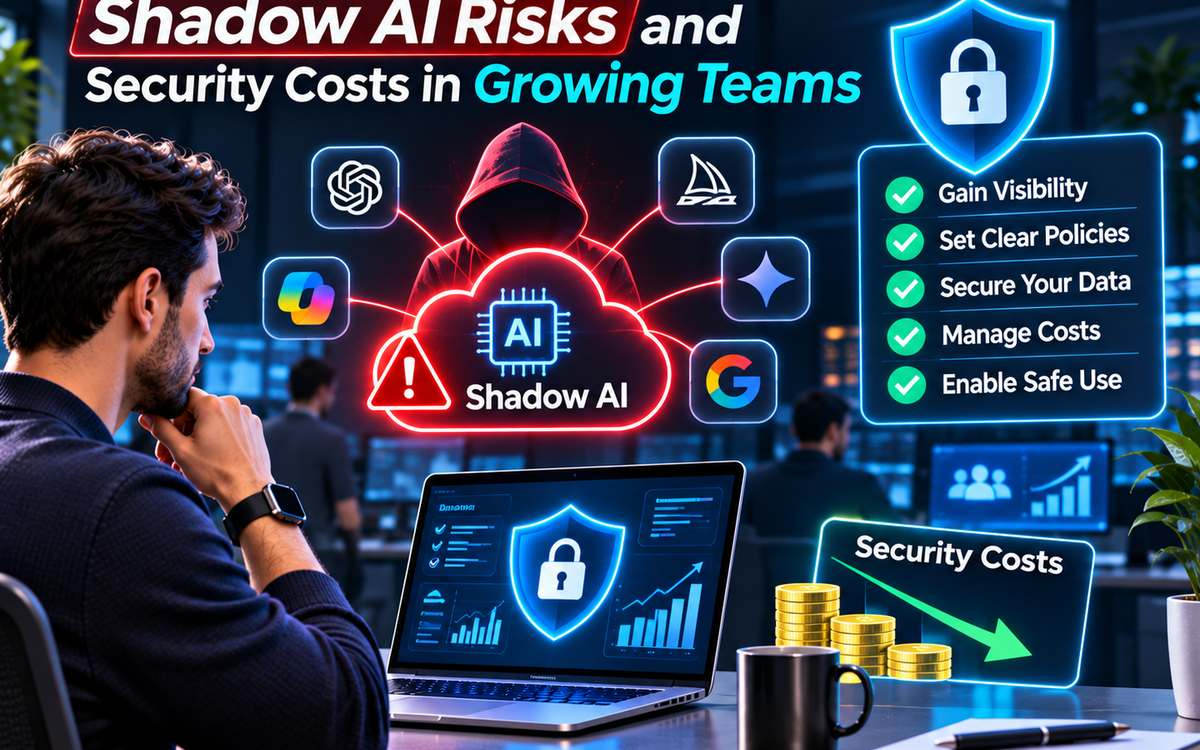

An employee subscribes to an AI writing assistant to prepare marketing content. Another uses a personal chatbot account to summarise customer emails. Meanwhile, a developer connects an AI coding tool to the company’s source code without consulting the IT department.
Individually, these decisions may appear harmless. Across a growing organisation, however, they can create significant financial, operational and security problems.
This is known as shadow AI.
As artificial intelligence becomes more accessible, employees no longer need formal technology approval to introduce powerful AI capabilities into their daily workflows.
The result is a growing number of businesses paying for tools they cannot properly monitor, sharing information with suppliers they have not assessed and exposing themselves to risks they may not recognise until something goes wrong.
In September 2026, the UK’s National Cyber Security Centre (NCSC) published guidance highlighting the hidden risks of shadow AI and the importance of providing employees with suitable, secure alternatives. National Cyber Security Centre
Managing shadow AI risks does not mean banning artificial intelligence altogether. It means establishing enough visibility, financial accountability and security oversight to make AI adoption sustainable.
What Is Shadow AI?
Shadow AI refers to the use of artificial intelligence tools, applications, models or automated systems within an organisation without appropriate knowledge, approval or oversight from its management or IT teams. It can expose businesses to uncontrolled spending, confidential information leakage, cybersecurity vulnerabilities and regulatory compliance risks.
Shadow AI can include free applications, paid subscriptions, browser extensions, AI-powered software integrations and independently developed automated workflows.
Common examples involve employees:
- Uploading confidential documents to personal AI accounts.
- Purchasing AI subscriptions without management approval.
- Installing unauthorised AI browser extensions.
- Connecting AI assistants to company email or cloud storage.
- Using unapproved coding assistants.
- Creating automated AI workflows that consume paid API resources.
- Activating AI features within existing business software without reviewing their data handling arrangements.
An application does not need to be malicious to create a shadow AI risk. A legitimate, widely used AI platform can still introduce problems when it operates outside established company policies.
Shadow AI vs Shadow IT: What Is the Difference?
Shadow IT describes technology used within an organisation without appropriate authorisation or oversight.
Shadow AI is a specific form of shadow IT involving artificial intelligence.
Traditional shadow IT might involve an employee using an unapproved file-sharing application or project management platform.
Shadow AI introduces additional considerations because AI applications can process information, generate new content, make recommendations and, in some configurations, perform actions through connected systems.
For example, an unauthorised storage application might retain a confidential document. An unauthorised AI assistant could process that document, generate summaries and use its contents in connected workflows.
This broader functionality makes understanding data handling, permissions and contractual arrangements particularly important.
Why Are Employees Using Unauthorised AI Tools?
Shadow AI often develops because employees are trying to solve genuine business problems.
Understanding their motivations is essential to creating effective AI governance policies.
Pressure to Improve Productivity
Employees may use AI to prepare reports, respond to emails, research topics or complete repetitive administrative work more quickly.
When approved solutions are unavailable, they may adopt personal alternatives.
Slow Software Approval Processes
Lengthy procurement procedures can encourage employees to bypass formal approval.
A marketing employee who needs an AI-assisted image editing tool may purchase a subscription rather than wait several weeks for a decision.
Lack of Approved AI Alternatives
Some businesses prohibit particular AI tools without offering suitable replacements.
Employees may continue using unauthorised services because they still need to complete the underlying work.
Limited Awareness of Security Risks
Not every employee understands how AI providers handle submitted information.
They may assume that uploading a document to an AI assistant is equivalent to editing it locally on their computer.
AI Features Embedded in Existing Software
Shadow AI is not limited to standalone applications.
Business software may introduce AI-powered meeting transcription, document summarisation, customer analytics or automated content generation.
These features can introduce new processing activities even when the original application has already been approved.
What Are the Biggest Shadow AI Security Risks?
Uncontrolled AI adoption can affect information security, intellectual property, regulatory compliance and everyday business operations.
1. Confidential Business Information Leakage
Employees may submit commercially sensitive information to AI tools without understanding how that information is processed.
This could include pricing strategies, supplier agreements, financial projections, internal communications or product development plans.
Depending on the provider, account type and settings, submitted information may be retained, reviewed or used for service improvement.
Businesses should verify the actual contractual and technical arrangements rather than assume that every AI platform handles information identically.
2. Customer Data Exposure
Customer information is particularly sensitive because businesses have legal responsibilities concerning personal data.
Uploading customer records, contact details, order histories or support conversations to an unapproved AI service may create data protection risks.
Removing names alone may not sufficiently anonymise information if individuals remain identifiable through other details.
3. Intellectual Property Risks
Developers, designers and marketing professionals may use AI applications to process proprietary materials.
Unauthorised use can create uncertainty around confidentiality, licensing and ownership rights.
Businesses should understand how their suppliers handle submitted materials and generated outputs.
4. Excessive Application Permissions
Some AI assistants request access to email accounts, calendars, cloud storage and other business systems.
Employees may approve these connections without understanding their scope.
An AI application with broad permissions could access significantly more information than required for its intended task.
5. Prompt Injection and Unintended Actions
AI agents may encounter instructions embedded within webpages, emails or documents.
Malicious content can potentially influence how an agent behaves, particularly when it has access to external tools.
An unauthorised agent with permission to modify records or send communications could introduce risks beyond inaccurate text generation.
6. Unverified AI Outputs
Employees may rely on AI-generated information without checking its accuracy.
Incorrect legal interpretations, fabricated references, misleading financial calculations and insecure code can create serious operational problems.
Human verification remains important even when an application has received formal approval.
7. Reduced Incident Response Visibility
When management does not know which AI applications employees use, investigating a suspected information exposure becomes more difficult.
The organisation may not know what information was submitted, when it was processed or whether it remains accessible.
The NCSC’s 2026 Annual Review identifies shadow AI as a factor that can increase organisations’ vulnerability to cybercriminals and other threat actors. National Cyber Security Centre
How Shadow AI Creates Hidden Business Costs
Security concerns receive considerable attention, but uncontrolled AI spending can also become a significant financial problem.
For growing businesses, costs often accumulate gradually across departments.
Duplicate AI Subscriptions
Several employees may purchase different AI tools that provide substantially overlapping functionality.
A business could be paying separately for writing assistance, document summarisation and research tools when an approved platform could support several of those requirements.
Unused Software Licences
Employees may subscribe to AI applications for a short-term project and forget to cancel them.
Automatic renewals can continue long after the original requirement disappears.
Personal Expense Claims
When employees purchase AI subscriptions using personal payment methods and submit expense claims, management may struggle to identify overall AI expenditure.
Individual claims may appear insignificant while collectively representing a substantial recurring cost.
Uncontrolled API Usage
Some AI services charge according to tokens, requests, processing time or other usage measurements.
An inefficient automated workflow could repeatedly process the same information or make unnecessary requests.
This can create unexpected expenditure even when the initial implementation appears inexpensive.
Additional Integration and Support Costs
Introducing several AI tools can create additional work for IT teams.
Each application may require separate configuration, security assessment, employee training and technical support.
Rework and Error Correction
AI-generated outputs are not automatically suitable for business use.
If employees spend considerable time correcting inaccurate content, the actual productivity benefit may be much smaller than expected.
Incident Remediation Costs
A security incident involving an unauthorised AI application may require investigation, legal assessment, system changes and communication with affected parties.
These potential costs should form part of the organisation’s wider AI risk assessment.
How Much Could Shadow AI Cost a Growing UK Business?
Consider a hypothetical digital services company with 40 employees.
Different departments have independently adopted AI tools, creating the following monthly expenditure:
- AI writing assistants: 15 subscriptions at £20 each, costing £300.
- AI research applications: 10 subscriptions at £25 each, costing £250.
- AI coding assistants: 8 subscriptions at £25 each, costing £200.
- AI design and image tools: 6 subscriptions at £20 each, costing £120.
- Usage-based AI API expenditure: £350.
- Unused or forgotten subscriptions: £180.
The combined monthly expenditure is £1,400, equivalent to £16,800 annually.
Following an internal review, suppose the business consolidates overlapping subscriptions, removes unused licences, retains necessary specialist tools and introduces API usage controls.
Its revised monthly expenditure is £850.
That produces an illustrative saving of £550 per month, or £6,600 annually, representing approximately 39.3% of the original expenditure.
These figures are hypothetical planning examples, excluding VAT. They do not represent verified supplier quotations, typical industry costs or guaranteed savings.
The example demonstrates why understanding total AI expenditure can be more valuable than simply negotiating individual subscription prices.
How to Identify Shadow AI Within Your Organisation
Businesses cannot effectively manage technology they do not know exists.
However, discovery should be proportionate and respectful of employee privacy.
Review Software Expenses
Examine company payment records, software invoices, recurring subscriptions and relevant employee expense claims.
Look for AI services purchased outside established procurement arrangements.
Understand How Employees Actually Work
Ask departments which AI tools they use, what tasks they support and why existing systems may not meet their requirements.
A constructive conversation can reveal information that technical monitoring alone would miss.
Review Business Application Integrations
Examine authorised third-party connections within company email, cloud storage, collaboration platforms and identity management systems.
Identify AI applications that have received unnecessary or unexpected permissions.
Assess Browser Extensions
Review extensions installed on managed company devices where appropriate.
Some AI extensions may request permission to read website content, interact with online forms or access business applications.
Examine API Usage
Review AI-related billing records, API credentials and automated workflows.
Identify services without a clear responsible owner or defined business purpose.
Maintain an AI Application Register
Record known AI tools, their users, business purposes, costs, data access and approval status.
A growing SME may initially manage this information through a controlled internal register rather than purchasing an expensive governance platform.
How to Control Shadow AI Costs and Security Risks
Effective shadow AI management combines financial oversight, practical security measures and employee engagement.
Step 1: Establish Clear Responsibility
Assign responsibility for AI governance within the organisation.
This could involve an IT manager, operational leader or designated cross-functional group.
Finance, security, data protection and relevant department managers should contribute where necessary.
The aim is to ensure that AI decisions have identifiable ownership.
Step 2: Create an Approved AI Tool Register
Evaluate existing tools and identify applications that meet the organisation’s operational and security requirements.
Employees should be able to find approved alternatives easily.
Approval should reflect the specific account type, configuration and intended use rather than simply the application’s brand name.
Step 3: Consolidate Overlapping Subscriptions
Compare applications according to functionality, usage and business value.
Remove unnecessary duplication while retaining specialist tools that provide meaningful advantages.
Consolidation should not prevent employees from accessing capabilities genuinely required for their work.
Step 4: Introduce AI Procurement Controls
Require appropriate approval before employees purchase new AI software or connect applications to sensitive systems.
The approval process should be proportionate to the cost and risk.
A low-risk drafting tool should not necessarily require the same assessment as an autonomous agent accessing financial records.
Step 5: Apply Data Classification Rules
Define which information employees can process using approved AI applications.
Public marketing materials may present relatively low confidentiality risks, while customer records, passwords, financial information and proprietary source code require greater protection.
Sensitive information should not be submitted to tools that have not been assessed for that purpose.
Step 6: Restrict Application Permissions
Give AI tools only the access required for their authorised activities.
Where practical, begin with read-only permissions.
Actions such as sending messages, changing customer records or initiating financial transactions should have suitable approval arrangements.
Step 7: Introduce AI Cost Management Controls
Assign subscriptions and API expenditure to responsible departments.
Use provider spending alerts, usage quotas and enforceable limits where supported.
Remember that billing alerts alone may not prevent additional charges.
Step 8: Review Performance Regularly
Evaluate whether approved AI tools deliver measurable benefits.
Consider accuracy, time savings, employee adoption, operating costs and security incidents.
These reviews should inform licence renewals and future procurement decisions.
How to Create an Effective AI Governance Policy
An AI governance policy should explain how employees can use artificial intelligence safely and responsibly.
It should be accessible, practical and understandable without requiring specialist technical knowledge.
Define Acceptable AI Use
Explain which activities are permitted, which require approval and which are prohibited.
For example, preparing a draft marketing email using public information may be permitted, while uploading confidential customer contracts to a personal chatbot account may be prohibited.
Establish Data Handling Requirements
Employees should understand what information can be shared with approved platforms.
The policy should explain restrictions concerning personal data, commercially sensitive information, credentials and proprietary materials.
Introduce Human Review Requirements
AI-generated outputs should receive appropriate review before being used in important business decisions or customer communications.
The level of review should reflect the consequences of an error.
Define Software Purchasing Procedures
Set out who can authorise AI subscriptions, approve integrations and review suppliers.
This helps avoid duplication and uncontrolled expenditure.
Establish Incident Reporting Procedures
Employees need a clear way to report suspected AI-related information exposure or incorrect automated actions.
A constructive reporting culture can help organisations identify problems sooner.
Review the Policy as Technology Changes
Artificial intelligence platforms evolve rapidly.
A policy written for basic chatbots may not adequately address autonomous AI agents and connected business applications.
Regular reviews help maintain relevance.
Shadow AI, UK GDPR and Data Protection Compliance
UK businesses processing personal information through AI systems must consider applicable data protection responsibilities.
Using an unauthorised application does not remove the organisation’s legal obligations.
Establish a Lawful Basis
Where AI tools process personal data, organisations need an appropriate lawful basis for that processing.
They should understand why the information is required and whether the intended use is justified.
Apply Data Minimisation
Employees should avoid submitting more personal information than necessary.
Where feasible, genuinely anonymised information or carefully selected extracts may provide a more appropriate alternative to complete customer records.
Assess AI Suppliers
Businesses should understand the provider’s role, contractual arrangements, information retention practices, subprocessors and relevant international data transfers.
An enterprise subscription may offer useful administrative and privacy controls, but it does not automatically establish compliance.
Conduct Data Protection Impact Assessments
A Data Protection Impact Assessment (DPIA) is required where proposed processing is likely to result in a high risk to individuals’ rights and freedoms.
AI implementations involving sensitive information, extensive monitoring or significant automated decisions may require particular attention.
Understand Personal Data Breach Responsibilities
If an unauthorised AI application receives personal information, the organisation should assess whether a personal data breach has occurred.
Where notification to the ICO is required, it must generally take place without undue delay and, where feasible, within 72 hours of becoming aware of the breach.
Not every unauthorised AI use automatically requires notification. The circumstances and associated risks must be assessed.
Can Employers Monitor Employees’ AI Usage?
UK employers can introduce monitoring for legitimate business purposes, but monitoring must comply with applicable data protection requirements.
Organisations should identify a lawful basis, explain their objectives, be transparent with employees and consider less intrusive alternatives.
For example, reviewing aggregate software expenditure may provide sufficient information about subscription costs without recording employees’ private conversations.
The ICO specifically highlights the risks associated with extensive device monitoring and recommends considering proportionate alternatives and appropriate impact assessments. ICO+1
Businesses should avoid using AI governance as a justification for unnecessary employee surveillance.
The objective should be protecting business information and managing technology responsibly, not monitoring every employee interaction.
How to Choose Approved AI Tools for Growing Teams
Selecting approved AI applications requires more than comparing subscription prices.
Businesses should evaluate whether a proposed tool supports appropriate administrative controls, access management, information protection and reliable workflows.
Security and Privacy
Review information retention, encryption, authentication and provider security arrangements.
Confirm whether submitted information may be used for model training or service improvement under the applicable plan.
Centralised Administration
Where available, organisational accounts can simplify employee onboarding, licence management and access removal when staff leave.
Cost Visibility
Look for billing information that allows management to understand expenditure by application, team or workload.
Usage-based services should provide sufficient visibility to identify unexpected consumption.
Integration Requirements
Assess which systems the AI application needs to access.
Avoid broad integrations when a more limited connection would meet the business requirement.
Business Value
The most expensive AI subscription is not necessarily the most effective.
Evaluate applications using representative business tasks and compare output quality, review time and total costs.
Managing Shadow AI in Different Business Departments
Different teams use artificial intelligence for different purposes. A single restrictive policy may not adequately address every workflow.
Digital Marketing Teams
Marketing professionals may use AI for content planning, keyword research, image generation and campaign reporting.
Approved workflows should address factual verification, intellectual property, brand consistency and confidential client information.
Employees should not upload private analytics exports or unpublished client strategies to unapproved applications.
Ecommerce Teams
Ecommerce businesses may use AI for product descriptions, customer support, inventory analysis and promotional campaigns.
Customer information, payment-related data and order histories require appropriate handling.
AI-generated product descriptions should also be checked to ensure they do not introduce misleading specifications or unsupported claims.
Web Development Teams
Developers may use AI coding assistants to generate code, investigate errors and explain technical documentation.
Organisations should consider source code confidentiality, software licensing, credential protection and code review.
AI-generated code should undergo suitable testing before production deployment.
Finance and Administration Teams
AI applications may help prepare reports, summarise documents and organise administrative information.
However, financial records, employee details and confidential contracts should only be processed through appropriately assessed systems.
Important financial calculations and decisions require suitable verification.
Customer Service Teams
AI can support response preparation and enquiry classification.
Businesses should establish clear boundaries around customer information, automated communications and escalation to human staff.
A Practical 30-Day Shadow AI Management Strategy
Growing businesses do not necessarily need a complex enterprise governance programme to begin addressing shadow AI.
A phased approach can establish essential controls without unnecessarily disrupting operations.
Week 1: Understand Current AI Usage
Review existing subscriptions, employee expense claims and known AI integrations.
Speak to department managers about the AI tools employees rely on and the problems those tools solve.
Establish an initial estimate of monthly AI expenditure and identify immediate security concerns.
Week 2: Assess Costs and Risks
Review known applications according to business purpose, permissions, information sensitivity and supplier arrangements.
Prioritise tools handling sensitive data or receiving broad access to business systems.
Identify duplicate subscriptions and unnecessary recurring expenses.
Week 3: Introduce Approved Alternatives
Communicate the organisation’s approved AI applications and acceptable use requirements.
Where existing tools must be removed, provide suitable replacements where possible.
Introduce centralised purchasing arrangements and relevant access controls.
Week 4: Establish Ongoing Governance
Assign responsible owners, introduce expenditure reviews and communicate incident reporting procedures.
Train employees on appropriate information handling and AI output verification.
Use the findings from the first month to establish a longer-term improvement plan.
The purpose of this strategy is to establish visibility and reduce immediate exposure, not to suggest that every AI governance issue can be resolved within 30 days.
How FinOps Can Help Businesses Manage AI Costs
Financial Operations, commonly known as FinOps, brings financial accountability and technology management together.
Although originally associated with cloud computing, its principles increasingly apply to artificial intelligence expenditure.
The FinOps Foundation’s 2026 State of FinOps report identifies AI expenditure management as a leading priority among its surveyed FinOps teams. FinOps Topic+1
For an SME, applying FinOps does not necessarily require a dedicated department.
Finance and technology leaders can establish regular reviews of subscription costs, usage-based charges and business outcomes.
A marketing team might measure AI expenditure against approved content produced. A development team could consider the cost of AI-assisted tasks alongside testing and code review requirements.
The objective is not simply to minimise spending. It is to ensure that expenditure delivers sufficient value.
How to Measure the Success of Your AI Governance Strategy
Effective governance requires meaningful performance measurements.
Total Monthly AI Expenditure
Track the combined cost of subscriptions, usage-based services, integrations and relevant support requirements.
Active Licence Utilisation
Compare purchased licences with actual usage to identify unnecessary recurring expenses.
Cost per Completed Task
Measure the cost of producing a useful business outcome rather than relying solely on the price of an individual AI request.
Net Productivity Improvements
Consider time saved after accounting for factual verification, correction and approval.
For example, an AI tool that produces a draft in five minutes but requires an hour of correction may offer limited efficiency.
Approved Tool Adoption
Monitor whether employees can complete their responsibilities using approved applications.
Low adoption may indicate that available tools do not adequately meet operational requirements.
Security and Privacy Incidents
Review reported incidents, excessive permissions and suspected information exposure.
Use these findings to improve policies and employee training rather than relying exclusively on punitive measures.
Common Shadow AI Management Mistakes
One of the biggest mistakes businesses make is banning all AI tools without understanding why employees adopted them.
Blanket restrictions can encourage staff to find alternative methods of accessing the technology.
Another mistake is assuming that a paid AI subscription automatically provides suitable security and privacy protections.
Businesses may also focus exclusively on subscription prices while ignoring usage-based charges, integration expenses and employee review time.
Excessive monitoring is another potential problem. Capturing unnecessary personal information can create additional privacy and legal risks.
Finally, organisations should avoid creating lengthy approval processes that discourage employees from requesting legitimate AI tools.
Effective governance should make responsible behaviour easier, not unnecessarily difficult.
Is Banning Shadow AI the Right Approach?
A complete ban on unauthorised AI applications may be appropriate for particular high-risk environments or sensitive activities.
However, a broader strategy should address the genuine reasons employees adopt these tools.
The NCSC recommends focusing on risk reduction, supporting constructive security practices and providing employees with appropriate AI solutions. National Cyber Security Centre
Businesses should distinguish between unacceptable information exposure and legitimate experimentation within controlled environments.
An employee testing AI-generated marketing ideas using public information presents a different risk from an autonomous agent connected to confidential financial systems.
Risk-based governance allows organisations to make these distinctions and introduce proportionate controls.
Conclusion: Managing Shadow AI Without Restricting Innovation
Shadow AI risks are becoming an important consideration for growing businesses as employees introduce artificial intelligence into more aspects of their work.
Uncontrolled adoption can result in duplicate subscriptions, unexpected API expenditure, confidential information exposure, excessive permissions and regulatory compliance problems.
However, these risks do not mean businesses should avoid artificial intelligence altogether.
The most effective response combines visibility, approved alternatives, financial accountability, clear governance policies and appropriate human oversight.
For UK businesses, AI adoption must also reflect applicable data protection obligations and employee privacy requirements.
By understanding how teams use AI, consolidating unnecessary expenditure and establishing practical security boundaries, businesses can benefit from artificial intelligence without losing control of their information or budgets.
Successful AI governance is not about preventing employees from using technology. It is about ensuring they can use the right technology responsibly, securely and cost-effectively.
10. FAQ Section
What is shadow AI in business?
Shadow AI is the use of artificial intelligence applications, services or automated systems without appropriate organisational approval or oversight. It can involve personal AI accounts, unapproved subscriptions, browser extensions and unauthorised integrations.
What are the biggest shadow AI risks?
Major risks include confidential information exposure, personal data breaches, excessive application permissions, intellectual property concerns, inaccurate outputs, uncontrolled spending and reduced visibility over business technology.
How can businesses prevent shadow AI?
Businesses can reduce shadow AI by providing approved alternatives, introducing clear usage policies, simplifying software approval, reviewing subscriptions, managing application permissions and educating employees about responsible AI use.
How does shadow AI increase business costs?
Shadow AI can increase expenditure through duplicate subscriptions, unused licences, uncontrolled API consumption, additional technical support and the costs associated with correcting errors or investigating security incidents.
Is shadow AI illegal in the UK?
Shadow AI is not automatically illegal. However, particular uses may breach data protection legislation, contractual confidentiality requirements or other applicable legal obligations. Each situation must be assessed according to its circumstances.
Can companies monitor employees using AI tools?
UK companies may introduce appropriate monitoring for legitimate purposes, provided they comply with applicable data protection requirements. Monitoring should be necessary, proportionate, transparent and supported by an appropriate lawful basis.
What is an AI governance policy?
An AI governance policy establishes rules for the selection, approval, use and management of artificial intelligence within an organisation. It typically addresses data protection, acceptable use, purchasing, permissions, human oversight and incident reporting.
Should small businesses invest in shadow AI management software?
Not necessarily. Smaller businesses can begin with a controlled AI application register, centralised procurement, approved tools and regular expenditure reviews. Specialist governance software may become appropriate as organisational complexity and risk increase.

Make Smarter Digital Investments Without Unnecessary Business Costs
Managing shadow AI highlights the importance of choosing the right digital tools, establishing clear business processes and ensuring technology investments deliver measurable value.
At CRAZILS, we help UK businesses and international clients strengthen their digital presence, improve customer experiences and develop practical digital growth strategies.
Our services include:
- Business Consultancy
- Web Design & Development
- Ecommerce Solutions
- Digital Marketing
- SEO
- UI/UX Design
- Content Creation & Marketing
- Website Maintenance & Support
Whether you’re reviewing your digital investment priorities, improving your website or developing a more effective online business strategy, we can help you explore solutions aligned with your goals.
Contact CRAZILS to discuss your next digital project.
Website: https://crazils.com
Email: info@crazils.com
Phone / WhatsApp: +44 7897 053081
WhatsApp: https://wa.me/447897053081
CRAZILS — Digital Solutions. Real Growth.