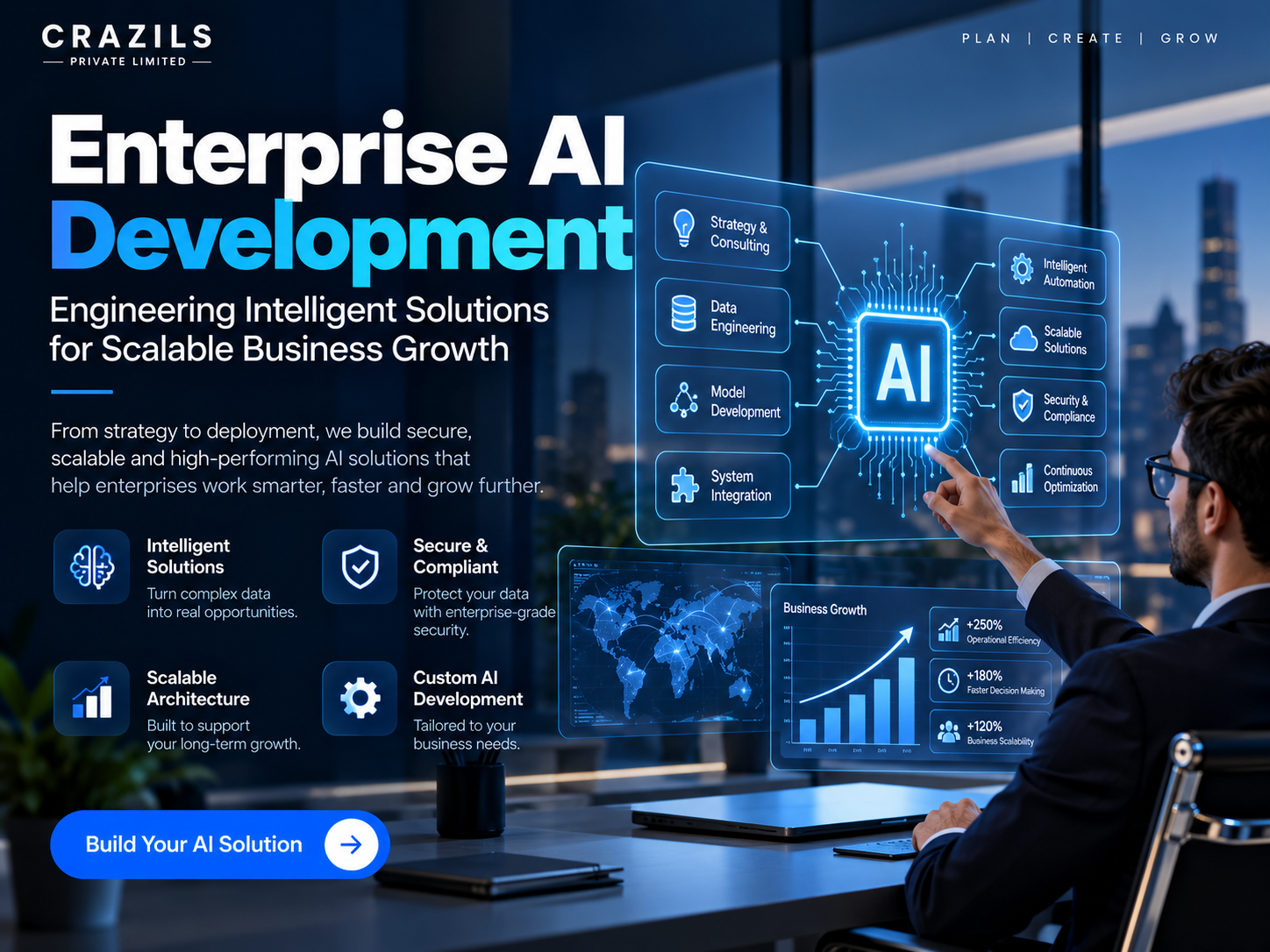


Artificial intelligence is moving from experimentation to infrastructure.
For many organizations, the question is no longer simply, “How can we use AI?” The more important question is, “How can we engineer AI systems that create measurable business value, integrate with existing operations, remain reliable at scale, and continue improving as the business evolves?”
That distinction matters.
Adding an AI chatbot to a website or testing a generative AI tool may provide short-term efficiency, but enterprise transformation requires something deeper. Businesses need intelligent systems that understand workflows, connect with trusted data, automate meaningful processes, support employees and customers, and operate within appropriate security and governance controls.
This is where enterprise AI development becomes important.
Enterprise AI development combines artificial intelligence, software engineering, data architecture, automation, cloud infrastructure, security, and business strategy to build intelligent solutions capable of operating in real-world organizational environments.
Done well, AI becomes more than another piece of software. It becomes a scalable capability that can help organizations work faster, make better-informed decisions, improve customer experiences, reduce repetitive work, and create new opportunities for growth.
This guide explores what enterprise AI development involves, where it can create value, how intelligent systems are engineered, and what businesses should consider when building an AI strategy for sustainable growth.
What Is Enterprise AI Development?
Enterprise AI development is the process of designing, building, integrating, deploying, and maintaining artificial intelligence solutions for organizations with complex business requirements.
Unlike isolated AI experiments, enterprise solutions usually need to work across existing technology environments, business processes, data sources, security policies, and teams.
An enterprise AI system might help a company analyze thousands of documents, automate customer support workflows, assist employees with internal knowledge, forecast demand, detect unusual transactions, personalize digital experiences, generate content, process operational data, or support complex decision-making.
The technology behind those solutions can include:
- Generative AI and large language models
- Machine learning
- Natural language processing
- Computer vision
- Predictive analytics
- Recommendation systems
- Intelligent automation
- AI agents and agentic workflows
- Retrieval and enterprise search
- Data engineering and analytics
The important point is that the AI model itself is only one component of the solution.
For enterprise environments, successful AI development also requires strong software architecture, quality data, reliable integrations, security, monitoring, governance, and a clear understanding of the business problem.
Enterprise AI Is About Business Problems, Not Technology Trends
AI initiatives can become expensive experiments when organizations begin with technology rather than the problem they want to solve.
A company sees generative AI gaining attention and decides it needs an AI application. Teams begin evaluating models and building prototypes before establishing what meaningful business outcome the system should improve.
The result may be technically impressive but commercially unimportant.
A better approach starts with questions such as:
Where is the organization losing time, money, accuracy, or opportunity?
Perhaps customer service teams repeatedly answer the same questions. Employees spend hours searching internal documentation. Sales representatives manually research accounts before meetings. Operations teams process large volumes of repetitive information. Managers struggle to turn fragmented data into actionable insight.
These are business problems first.
AI is valuable when it provides an appropriate way to solve them.
Before development begins, organizations should define:
- The business problem
- The people affected by it
- The current workflow
- The expected improvement
- The data required
- The acceptable level of risk
- How success will be measured
This prevents AI strategy from becoming a collection of disconnected experiments.
The strongest enterprise AI solutions are engineered around measurable business outcomes, not around the novelty of the underlying model.
Why Businesses Are Investing in Intelligent Solutions
Enterprise AI can create value across multiple parts of an organization, but the benefits depend heavily on the quality of implementation.
One important opportunity is operational efficiency.
Many employees still spend significant portions of their day moving information between systems, preparing repetitive reports, reviewing documents, searching for answers, categorizing requests, or completing administrative processes.
AI can assist with parts of these workflows, allowing people to spend more time on tasks requiring judgment, relationships, creativity, and domain expertise.
Another opportunity is improved access to information.
Large organizations often possess enormous amounts of valuable knowledge spread across documents, databases, emails, knowledge bases, CRM platforms, support systems, and internal applications. The problem is not always a lack of information. It is finding the right information at the right moment.
Intelligent search and retrieval systems can help employees interact with organizational knowledge more naturally.
AI can also improve customer experiences through faster support, better recommendations, personalization, intelligent routing, and more responsive digital services.
The objective should not simply be automation for the sake of automation.
The objective is to identify areas where intelligence can improve how the organization operates and creates value.
From AI Prototype to Enterprise-Ready System
Building a prototype has become relatively easy.
Building an AI system that an organization can depend on is considerably harder.
A prototype may demonstrate that an AI model can perform a particular task. An enterprise-ready solution must demonstrate that the entire system can perform that task reliably, securely, economically, and repeatedly under real operating conditions.
That introduces questions a simple demonstration may never encounter.
What happens when thousands of users access the system simultaneously?
How does the application handle incorrect or incomplete outputs?
What information is the model permitted to access?
How are permissions enforced?
What happens if a model provider becomes unavailable?
How are AI outputs monitored?
How is sensitive information protected?
How much does every interaction cost?
How will the system behave when the underlying model changes?
How can the organization determine whether performance is improving or deteriorating?
These questions illustrate why enterprise AI development is fundamentally an engineering discipline.
The intelligence layer matters, but so do all the systems surrounding it.
The Architecture Behind Scalable Enterprise AI
A robust enterprise AI platform may contain several interconnected layers.
The exact architecture depends on the use case, but a modern intelligent application often needs much more than a model API.
The Experience Layer
This is where employees or customers interact with the system.
It could be a web application, mobile app, conversational assistant, customer portal, internal dashboard, CRM interface, or feature embedded within existing software.
The experience should be designed around the user’s workflow rather than forcing users to adapt to the AI.
The Application and Orchestration Layer
This layer manages business logic.
It may determine which model should handle a request, retrieve relevant information, call internal tools, execute workflows, validate responses, and coordinate multiple steps.
For sophisticated systems, this is also where AI agents and workflow orchestration may operate.
The AI and Model Layer
Different tasks may require different models.
Organizations may use large language models for language-intensive tasks, specialized machine-learning models for prediction, computer vision for image analysis, or smaller models for high-volume tasks where speed and cost matter.
An enterprise architecture should avoid assuming that one model is ideal for every problem.
The Data and Knowledge Layer
AI systems become substantially more useful when they can work with trusted organizational information.
This layer may include:
- Databases
- Data warehouses
- Document repositories
- Vector databases
- Knowledge bases
- CRM data
- Product information
- Operational systems
- APIs
Strong data architecture is therefore essential to strong AI architecture.
The Security and Governance Layer
Access control, authentication, logging, encryption, privacy controls, policy enforcement, evaluation, and auditability should be considered part of the architecture—not features added after deployment.
The Observability Layer
Enterprise teams need visibility into how the system behaves.
Monitoring can include latency, errors, model usage, costs, output quality, user feedback, retrieval quality, workflow failures, and other business-specific indicators.
Together, these layers transform an AI capability into a usable business system.
Enterprise Data Is Often the Real Competitive Advantage
Organizations frequently focus on which AI model they should use.
Models matter, but proprietary business data can be equally important to the usefulness of an enterprise AI application.
Public AI models understand broad patterns from their training. They do not automatically understand your company’s latest product documentation, internal procedures, customer accounts, inventory, pricing, contracts, policies, or operational knowledge.
That information exists inside the business.
Connecting AI safely to that knowledge can make the system significantly more relevant.
For example, imagine an internal assistant used by a technical support team.
A generic model may understand the general technology category. But an enterprise solution could retrieve information from approved product documentation, troubleshooting guides, historical support knowledge, and current internal policies before generating an answer.
The difference is substantial.
One produces a general response.
The other can produce an answer grounded in the organization’s approved information.
This is one reason retrieval-augmented generation (RAG) has become useful in enterprise AI architectures.
Rather than expecting a model to contain every piece of business knowledge, the application retrieves relevant information from approved sources and provides that context to the model when needed.
However, retrieval itself needs careful engineering. Poor document quality, outdated information, weak permissions, or inaccurate retrieval can still produce poor results.
AI cannot magically repair an organization’s entire information architecture.
In many cases, better AI begins with better data management.
Generative AI for Enterprise Applications
Generative AI has created opportunities to build applications that interact with language, documents, images, code, and other unstructured information in more flexible ways.
Within an enterprise environment, generative AI can support tasks such as:
- Summarizing lengthy documents
- Drafting business communications
- Extracting structured information
- Searching internal knowledge
- Generating reports
- Assisting customer support
- Supporting software development
- Creating personalized content
- Analyzing feedback
- Helping employees research information
But production systems should not assume that generated outputs are always correct.
Large language models can produce incomplete, inaccurate, or unsupported responses.
That means organizations need safeguards appropriate to the importance of the task.
A marketing copy assistant may tolerate more creative variation than a system involved in financial, legal, medical, safety, or other high-impact decisions.
The level of control should match the level of risk.
AI Agents and Intelligent Workflow Automation
One of the most significant developments in enterprise AI is the shift from systems that only answer questions toward systems that can help complete multi-step workflows.
An AI agent can potentially interpret an objective, gather relevant information, interact with approved tools, perform defined actions, and coordinate steps toward an outcome.
Consider a sales workflow.
Instead of simply asking an AI system to summarize a prospect, an intelligently orchestrated workflow could:
- Retrieve approved CRM information.
- Analyze previous interactions.
- Research available internal account data.
- Summarize relevant opportunities.
- Draft meeting preparation notes.
- Suggest follow-up actions.
- Prepare a personalized email draft for employee review.
The value isn’t merely better text generation.
The value comes from reducing the number of disconnected manual steps required to complete meaningful work.
However, giving AI access to tools introduces additional risks.
Organizations need to determine what an AI agent can read, what it can change, what actions require human approval, how actions are logged, and how errors can be reversed.
For high-impact workflows, human oversight remains an important design principle.
Autonomy should be earned through testing and evidence rather than assumed from the beginning.
Where Enterprise AI Can Create Business Value
There is no single “best” enterprise AI use case. The right opportunities depend on the organization’s industry, processes, data, customers, and maturity.
However, several categories are particularly relevant.
Customer Experience
AI can help businesses deliver faster and more personalized digital experiences.
Potential applications include intelligent support assistants, recommendation systems, automated ticket classification, multilingual assistance, personalized product discovery, and agent-assist tools for customer service teams.
The goal should not be to remove human interaction everywhere.
For complex or sensitive situations, customers may still need people.
The stronger model is often AI for efficiency combined with human expertise where it matters most.
Sales and Marketing
Sales teams can use intelligent systems to summarize customer information, identify patterns, assist research, personalize communications, prioritize opportunities, and prepare meeting materials.
Marketing teams can use AI for content workflows, audience research, campaign analysis, creative experimentation, and personalization.
The important distinction is between using AI simply to produce more content and using AI to improve the quality and efficiency of the entire marketing workflow.
Operations
Operational processes frequently contain repetitive, information-heavy tasks that are good candidates for intelligent automation.
AI can assist with document processing, workflow routing, quality monitoring, demand forecasting, anomaly detection, reporting, and operational analysis.
Enterprise Knowledge
Internal knowledge assistants can make information easier for employees to discover.
Instead of manually searching multiple repositories, employees can ask questions in natural language and receive responses grounded in authorized internal information.
Software Engineering
AI-assisted engineering can support developers with code explanation, documentation, testing, debugging, migration, code generation, and internal development workflows.
It should enhance engineering capability rather than replace sound architecture, code review, testing, and security practices.
Scalability Is More Than Handling More Users
When businesses hear scalable AI solutions, they often think about infrastructure capable of supporting increased traffic.
That is certainly part of scalability.
But enterprise scalability has several dimensions.
Technical Scalability
Can the system support increasing users, requests, integrations, and data without becoming unstable?
Financial Scalability
If usage increases tenfold, does the cost structure remain commercially sustainable?
An AI application that costs more to operate than the value it creates is not truly scalable.
Organizational Scalability
Can different departments use the system while maintaining appropriate permissions and governance?
Data Scalability
Can the architecture manage growing data volumes while preserving quality, freshness, access controls, and retrieval performance?
Operational Scalability
Can teams monitor, maintain, evaluate, and improve the system without creating an unsustainable operational burden?
True scalability means designing for all five.
Security and Governance Must Be Designed From the Beginning
Enterprise AI systems may interact with customer information, proprietary documents, internal communications, financial data, intellectual property, or other sensitive information.
Security therefore cannot be an afterthought.
Depending on the application, important controls can include:
- Role-based access
- Authentication and authorization
- Data encryption
- Secure API management
- Audit logs
- Data-loss controls
- Environment separation
- Input and output safeguards
- Vendor risk assessment
- Human approval for sensitive actions
- Monitoring and incident response
Organizations should also define clear governance around appropriate AI use.
Employees need to understand what information can be entered into AI systems, which applications are approved, how outputs should be validated, and where human judgment is mandatory.
Strong governance does not necessarily slow innovation.
Done properly, it gives teams a safer framework within which to innovate.
Human-in-the-Loop AI Still Matters
The most effective enterprise AI system is not always the one with maximum autonomy.
Sometimes the better system is one that knows when to involve a person.
Consider an AI assistant that processes customer refund requests.
It might automatically handle routine requests that fall within clearly defined policies while escalating unusual, high-value, disputed, or potentially fraudulent cases to an employee.
This approach combines machine efficiency with human judgment.
Human review may be particularly valuable when:
- Financial consequences are significant
- Information is ambiguous
- Decisions affect people’s rights or opportunities
- Regulatory requirements apply
- Confidence is low
- The action is difficult to reverse
- Emotional or relationship context matters
The objective should be appropriate automation, not maximum automation.
How to Build an Enterprise AI Solution: A Practical Framework
Successful AI development usually benefits from an iterative approach rather than attempting a massive organization-wide transformation immediately.
Step 1: Identify a Valuable Business Problem
Start with an operational or customer problem that is meaningful enough to justify investment.
Understand the current process and establish a baseline.
If employees currently spend 1,000 hours per month on a workflow, document it. If customer response time averages six hours, measure it. If a process has a known error rate, record it.
Without a baseline, demonstrating improvement becomes difficult.
Step 2: Evaluate AI Suitability
Not every problem requires AI.
Sometimes traditional automation, better software, improved processes, or simpler rules can solve the problem more reliably and cheaply.
Use AI when the task genuinely benefits from capabilities such as language understanding, prediction, classification, pattern recognition, content generation, or reasoning across complex information.
Step 3: Assess Data Readiness
Determine what information the system requires.
Review:
- Availability
- Quality
- Accuracy
- Permissions
- Privacy
- Structure
- Freshness
- Ownership
Data limitations discovered early are much cheaper to address than data problems discovered after deployment.
Step 4: Build a Focused Prototype
Create a controlled proof of concept around a narrow, valuable workflow.
The goal is not simply to prove that the technology works.
The prototype should help answer whether the solution can deliver meaningful value under realistic conditions.
Step 5: Evaluate System Quality
Testing AI applications requires more than traditional software testing.
Teams may need to evaluate:
- Accuracy
- Relevance
- Groundedness
- Retrieval quality
- Latency
- Reliability
- Safety
- Cost per interaction
- User satisfaction
- Task completion
Evaluation datasets should represent realistic user behavior rather than only ideal examples.
Step 6: Integrate With Business Systems
Enterprise value often appears when AI becomes part of an existing workflow.
That may require integrations with CRM platforms, databases, document repositories, ERP systems, communication platforms, customer support software, or internal applications.
Step 7: Deploy With Appropriate Controls
Start with controlled access when appropriate.
Monitor real usage, collect feedback, identify failure patterns, and expand gradually as confidence increases.
Step 8: Continuously Improve
AI development does not end at launch.
Models change. Business information changes. User behavior changes. Costs change. New failure patterns appear.
Production AI therefore requires continuous monitoring, evaluation, optimization, and governance.
Measuring the ROI of Enterprise AI
An AI initiative should eventually answer a straightforward question:
What business value is this creating?
The correct metric depends on the use case.
For an internal productivity system, success might involve time saved per task and employee adoption.
For customer support, metrics might include response time, resolution rate, escalation rate, customer satisfaction, and cost per interaction.
For sales, organizations might monitor qualified opportunities, research time, sales-cycle efficiency, or conversion improvements.
For ecommerce, metrics could include recommendation engagement, conversion rate, average order value, support efficiency, or repeat purchase behavior.
Useful categories include:
Efficiency metrics: time saved, cost reduction, automation rate, throughput.
Quality metrics: accuracy, error reduction, consistency, customer satisfaction.
Growth metrics: revenue influenced, conversions, retention, qualified opportunities.
AI system metrics: latency, failure rate, model cost, retrieval quality, escalation rate.
Avoid relying on impressive technical demonstrations as evidence of ROI.
Business outcomes are ultimately more important than AI activity.
Common Enterprise AI Development Mistakes
Many AI initiatives struggle for predictable reasons.
One is attempting to automate a poorly understood process. AI cannot compensate for a workflow that nobody has clearly defined.
Another is ignoring data quality. If the system retrieves outdated or contradictory information, sophisticated models will not automatically make that information reliable.
Organizations can also make the mistake of selecting technology before defining requirements.
Other common problems include:
- Trying to automate too much too quickly
- Ignoring security until late development
- Having no meaningful evaluation framework
- Assuming AI outputs are always correct
- Failing to involve actual end users
- Measuring usage instead of business value
- Building isolated AI tools with no workflow integration
- Underestimating ongoing operating costs
- Giving agents excessive permissions
- Launching without monitoring
- Treating AI implementation as a one-time project
A successful enterprise AI program requires both technical discipline and business discipline.
Build vs. Buy: Which Approach Makes Sense?
Organizations do not necessarily need to build every AI capability from scratch.
There are generally three approaches.
Buy: Adopt an existing AI product for a standardized business need.
Build: Develop a custom solution when the workflow, data, integration, user experience, or competitive requirements are sufficiently unique.
Hybrid: Combine existing AI platforms or models with custom applications, integrations, data pipelines, and business logic.
For many enterprises, the hybrid approach can be practical.
It allows teams to use mature foundational technology while engineering the parts that create specific business value.
The decision should consider:
- Strategic importance
- Customization requirements
- Data sensitivity
- Integration complexity
- Time to market
- Total cost of ownership
- Internal technical capabilities
- Vendor dependency
- Scalability requirements
The goal isn’t to build the most sophisticated AI stack.
It is to build the right system for the business problem.
Enterprise AI Should Strengthen People, Not Just Replace Tasks
Some of the strongest applications of AI are not complete replacements for human work.
They are systems that make skilled people more effective.
A customer service representative with immediate access to relevant knowledge can resolve problems faster.
A salesperson with automated research can spend more time speaking with prospects.
An analyst who can interrogate large datasets conversationally can explore ideas more quickly.
A developer with intelligent assistance can spend less time on repetitive tasks.
A marketing team can accelerate research and experimentation while retaining human judgment over positioning and brand quality.
This creates an important principle for enterprise AI:
Don’t only ask which jobs AI can automate. Ask which capabilities AI can amplify.
That mindset often leads to more useful and sustainable implementations.
Creating an Enterprise AI Roadmap for Scalable Growth
Businesses do not need to transform everything at once.
A practical AI roadmap can progress through stages.
Phase 1: Discover
Identify high-value problems, evaluate processes, assess data readiness, and establish priorities.
Phase 2: Validate
Build focused prototypes and determine whether they deliver meaningful improvements.
Phase 3: Integrate
Connect validated AI capabilities with real systems, workflows, users, and data.
Phase 4: Scale
Expand successful solutions across more users, departments, customers, or markets.
Phase 5: Optimize
Improve models, prompts, retrieval, infrastructure, cost, UX, and workflows based on evidence.
Phase 6: Govern
Maintain security, monitoring, policies, permissions, accountability, and continuous evaluation throughout the lifecycle.
Governance should not really wait until Phase 6—it should exist from the beginning—but it becomes increasingly important as adoption grows.

The Future of Enterprise AI Is Connected Intelligence
The long-term value of enterprise AI is unlikely to come from hundreds of disconnected AI tools.
The greater opportunity is connected intelligence embedded throughout business operations.
A customer request might enter through a digital platform, be classified by AI, enriched with CRM information, routed to the appropriate workflow, supported by an internal knowledge system, reviewed by a person where necessary, and analyzed later to improve future customer experiences.
The intelligence becomes part of the infrastructure.
That is a much more powerful vision than simply adding a chatbot to every application.
Businesses that approach AI strategically can build systems in which data, automation, software, AI, and human expertise work together.
Final Thoughts: Intelligent Technology Needs Intelligent Engineering
Enterprise AI has enormous potential, but successful implementation requires more than access to powerful models.
Businesses need to understand the problem first.
They need reliable data, thoughtful architecture, secure integrations, appropriate governance, strong user experiences, measurable objectives, and a process for continuous improvement.
Most importantly, they need to connect AI investment with genuine business value.
The goal of enterprise AI development should not be to make an organization appear more technologically advanced.
It should be to build intelligent systems that make the organization meaningfully better at what it does.
That could mean serving customers faster, giving employees better tools, improving decisions, reducing operational friction, creating new digital products, or enabling growth that existing processes cannot efficiently support.
When AI strategy, software engineering, data, automation, and human expertise are designed as one system, artificial intelligence moves beyond experimentation.
It becomes part of how the business grows.
And that is where enterprise AI becomes truly valuable: not intelligence for its own sake, but intelligently engineered solutions built for scalable business growth. Let’s Book Short Meeting Or Contact With Our Social Media Tam
Related News
AI Agents For Business Automation with Autonomous Intelligence

7 Signs Your Business Website Needs Redesign

Website Design Trends Businesses Should Know in 2026

How to Perform a Competitor Analysis for Your Business

How Professional Graphic Design Influences Customer Trust
Popular News