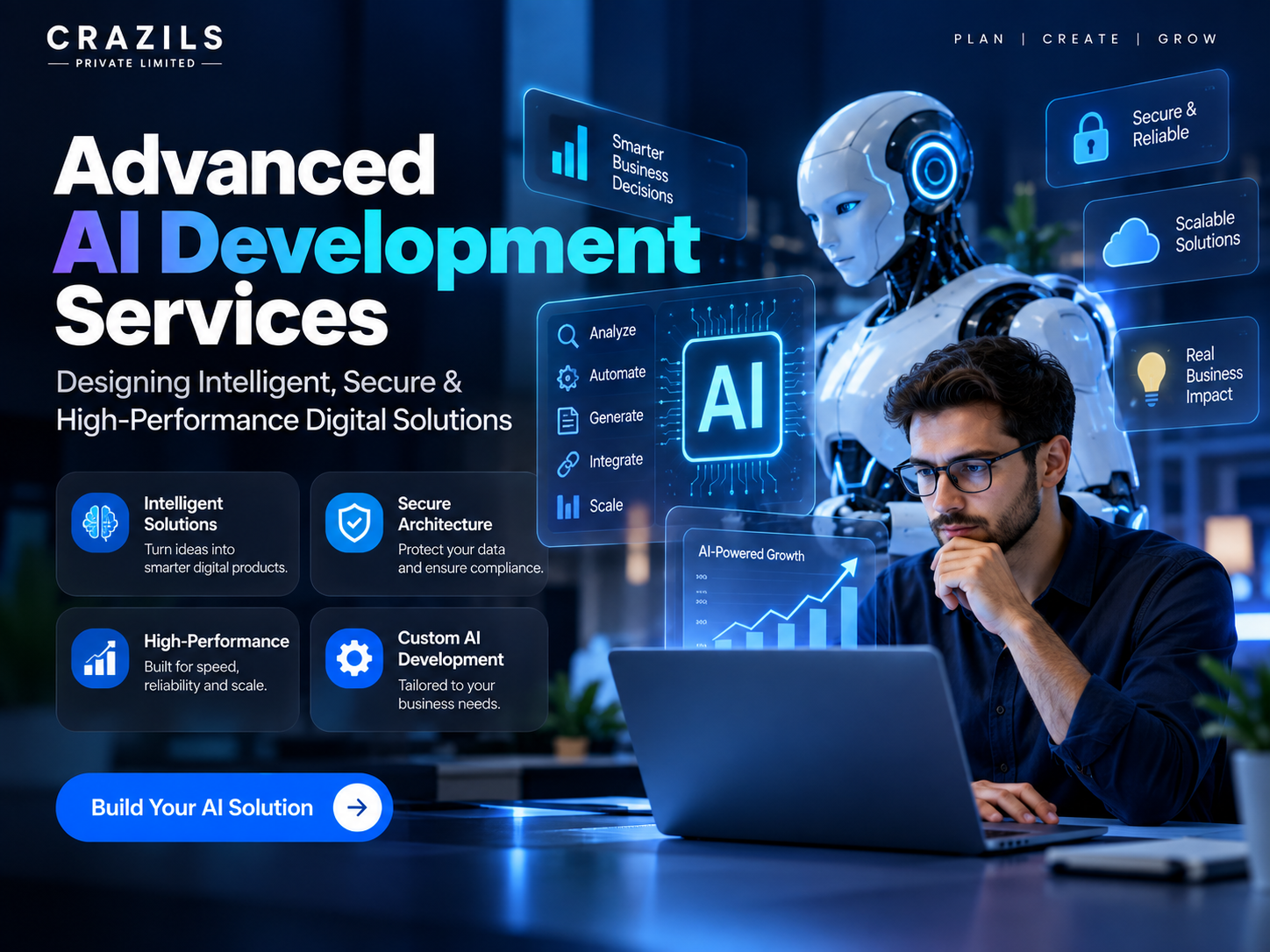


Artificial intelligence has moved far beyond experimental chatbots and futuristic concepts. Today, businesses are using AI to automate complex workflows, understand large volumes of data, improve customer experiences, accelerate decision-making, and build entirely new digital products.
But adding AI to a business is not as simple as connecting an API and calling a project “intelligent.”
A successful AI solution needs to understand the business problem, work reliably with existing systems, protect sensitive information, perform efficiently at scale, and deliver an experience that people can actually trust and use.
That is where advanced AI development services become valuable.
Professional AI development brings together strategy, machine learning, generative AI, software engineering, data infrastructure, security, user experience, testing, and continuous optimization to create solutions designed around real business requirements.
The objective is not to use AI simply because it is available. The objective is to use it where it can create meaningful value.
In this guide, we explore how businesses can approach AI development strategically and what it takes to build intelligent, secure, scalable, and high-performance digital solutions.
What Are Advanced AI Development Services?
AI development services involve designing, developing, integrating, and maintaining software systems that use artificial intelligence to perform tasks that traditionally required human analysis, decision-making, communication, or pattern recognition.
Depending on the business requirement, an AI solution might analyze information, generate content, answer questions, recommend products, classify documents, automate repetitive processes, identify patterns, or assist employees with complex tasks.
Modern AI development can include technologies such as machine learning, natural language processing, generative AI, large language models, computer vision, recommendation systems, predictive analytics, intelligent automation, and AI agents.
The technology itself, however, is only part of the solution.
A professionally developed AI system must also consider:
- Business objectives
- Data quality and availability
- Application architecture
- User experience
- Privacy and security
- Model selection
- Integrations
- Performance
- Reliability
- Monitoring
- Scalability
- Cost efficiency
This broader approach separates a useful AI product from an impressive technical demonstration.
AI Development Should Start With a Business Problem
One of the most common mistakes businesses make with artificial intelligence is starting with the technology rather than the problem.
A company discovers a powerful AI model and immediately asks:
“How can we use this?”
A better question is:
“Which business problem could AI help us solve more effectively?”
That small change in perspective can dramatically improve the quality of an AI project.
For example, a company may be struggling with thousands of repetitive customer questions. Another may have employees spending hours extracting information from documents. An ecommerce business might need better product recommendations, while a professional services company may want employees to find information across internal knowledge more efficiently.
Each situation requires a different solution.
Before development begins, businesses should understand the desired outcome. Is the goal to reduce repetitive work? Improve response times? Increase conversion rates? Help teams make better decisions? Personalize customer experiences? Process information faster?
AI becomes valuable when its capabilities are connected to a measurable business need.
From Simple Automation to Intelligent Digital Systems
Traditional automation usually follows predetermined rules.
For example:
If X happens → perform Y action.
This works extremely well for predictable processes.
AI becomes particularly useful when the task involves language, patterns, context, classification, prediction, or information that cannot always be handled effectively through fixed rules alone.
Consider customer support.
A traditional system might direct users through a predefined menu. An AI-powered system can potentially interpret the customer’s question, search relevant knowledge, formulate an appropriate response, and escalate the conversation when human involvement is required.
The important point is that AI does not automatically replace traditional software or automation.
In many strong systems, the technologies work together.
Traditional software provides deterministic business logic. Databases maintain structured information. APIs connect platforms. Automation handles predictable workflows. AI provides intelligence where flexible interpretation or generation is useful.
The result is not “AI everywhere.”
It is AI where intelligence adds value.
Core AI Development Services for Modern Businesses
The right AI architecture depends on the use case, but several categories have become particularly important for modern digital products.
Generative AI Application Development
Generative AI can help applications create, transform, summarize, organize, and interact with information.
Businesses can use generative AI for applications such as intelligent assistants, content workflows, document analysis, internal knowledge systems, customer support, research tools, and productivity platforms.
A production-ready generative AI application requires much more than a text box connected to a language model.
Developers need to consider prompt architecture, context management, data retrieval, model behavior, permissions, response validation, latency, costs, security, and fallback mechanisms.
The interface must also clearly communicate what the AI can and cannot reliably do.
AI Chatbots and Intelligent Assistants
Modern AI chatbot development can create much more sophisticated experiences than traditional scripted chatbots.
An intelligent assistant can potentially understand natural-language questions, access approved information, maintain relevant conversational context, interact with business systems, and help users complete specific tasks.
Possible applications include:
- Customer support assistants
- Ecommerce shopping assistants
- Internal employee assistants
- Sales qualification tools
- Appointment support
- Knowledge-base assistants
The best chatbot is not necessarily the one capable of discussing the largest number of topics.
It is the one that reliably helps users accomplish the intended task.
For that reason, successful chatbot development requires clear boundaries, high-quality information sources, appropriate escalation to humans, and careful testing.
Custom AI Software Development
Off-the-shelf AI products are useful, but they cannot address every workflow.
Organizations with specialized requirements may need custom AI development integrated directly into their software environment.
A custom solution can be designed around specific business logic, datasets, workflows, permissions, interfaces, and integrations.
For example, a custom AI application might analyze incoming documents, extract important fields, validate information against internal rules, send uncertain cases for human review, and update another business system after approval.
The value comes from the complete workflow—not merely the model performing one task.
AI Agents and Agentic Workflows
One of the most significant developments in AI software is the move from systems that only generate responses toward systems capable of working through multi-step tasks.
AI agents can be designed to reason over available context, use approved tools, retrieve information, interact with APIs, and perform controlled actions.
For example, an internal AI agent could potentially receive a request, locate relevant information, analyze it, prepare a draft, update an approved system, and request human authorization before performing a sensitive action.
This opens interesting opportunities for:
- Operations
- Customer support
- Research
- Sales workflows
- Reporting
- Data processing
- Internal productivity
However, greater autonomy introduces greater responsibility.
An agent that can take actions needs stronger controls than a chatbot that only produces text.
Permissions should be limited. Sensitive actions may require approval. Actions should be logged. External inputs should be treated carefully. Failures need predictable recovery mechanisms.
The more an AI system can do, the more important controlled architecture becomes.
Retrieval-Augmented Generation and Business Knowledge
General-purpose AI models know a great deal, but they do not automatically understand a company’s private documents, current policies, product catalogues, internal processes, or proprietary knowledge.
This is where retrieval-augmented generation (RAG) can be useful.
Instead of relying entirely on information encoded within a model, a RAG system retrieves relevant information from approved sources and supplies that context when generating a response.
Imagine an employee asking:
“What is our current refund process for enterprise customers?”
Rather than expecting the AI model to know the answer independently, the application can retrieve the relevant internal policy and use it as context.
This approach can support:
- Internal knowledge assistants
- Customer-support systems
- Policy search
- Product information assistants
- Technical documentation
- Research applications
- Document intelligence
But RAG is not automatically reliable.
Retrieval quality, document structure, permissions, indexing, metadata, context selection, evaluation, and source freshness all affect performance.
If the system retrieves the wrong information, even an excellent language model can produce a poor answer.
Machine Learning and Predictive Solutions
Not every AI project needs generative AI.
Traditional machine learning development remains extremely useful when businesses need to identify patterns, classify information, forecast outcomes, or generate recommendations from structured data.
Depending on the available data and use case, machine learning can support areas such as demand forecasting, anomaly detection, customer segmentation, recommendation systems, predictive maintenance, and risk analysis.
The effectiveness of these systems depends heavily on the underlying data.
More data is not automatically better.
Businesses need data that is relevant, appropriately prepared, representative of the intended use case, and suitable for the decisions the system is expected to support.
This is why serious AI development frequently begins with data engineering and data quality, not model training.
Computer Vision Solutions
Computer vision allows software to process and interpret visual information.
Depending on the application and available technology, computer vision can support tasks involving images, video, documents, objects, quality inspection, and visual classification.
Potential business applications can include:
- Product image analysis
- Document processing
- Manufacturing quality inspection
- Visual search
- Inventory-related workflows
- Image categorization
- Media analysis
As with other AI technologies, accuracy should be evaluated against the specific environment in which the system will operate.
A model performing well on carefully selected development data does not necessarily guarantee equivalent performance in real-world conditions.
Intelligent Process Automation
Many businesses do not need a completely new AI product.
They need their existing workflows to become smarter.
AI-powered automation can combine traditional workflow automation with language models, machine learning, APIs, and business rules.
Imagine a business receiving hundreds of inquiries every day.
An intelligent workflow could help:
- Analyze the incoming inquiry.
- Categorize it based on intent.
- Extract relevant information.
- Route it to the appropriate department.
- Prepare a suggested response.
- Flag unusual or sensitive cases for human review.
- Record approved information in the relevant system.
The greatest benefit often comes from reducing repetitive administrative work while keeping people involved where judgment, accountability, or customer relationships matter.
Secure AI Development Must Be Built In From the Beginning
AI security should not be something added shortly before launch.
AI applications can interact with sensitive information, third-party models, databases, APIs, uploaded files, user prompts, internal tools, and external services.
Every additional connection can introduce risk.
A secure AI development strategy should consider the entire application architecture.
Depending on the project, important controls may include:
- Authentication and authorization
- Role-based permissions
- Encryption
- Secure API handling
- Data minimization
- Secret and credential management
- Input validation
- Output controls
- Audit logging
- Rate limiting
- Monitoring
- Data retention policies
- Human approval for sensitive actions
AI-specific risks also need consideration.
For example, applications that use external content or tool access should be designed with the possibility of malicious or misleading instructions in mind.
Security therefore needs to exist at several levels: the model, application, data, infrastructure, integrations, and user permissions.
Privacy Matters Just as Much as Security
Security asks whether information is protected.
Privacy also asks whether the information should be collected, processed, retained, or shared in the first place.
Businesses developing AI applications should understand what information enters the system, where it travels, how long it remains, which providers may process it, and who can access it.
Before sending information to an AI service, teams should consider whether that information includes:
- Personal information
- Customer records
- Confidential business information
- Financial information
- Proprietary documents
- Authentication credentials
- Regulated or otherwise sensitive data
Not every application needs access to every piece of information available to the organization.
Data minimization can improve both privacy and security.
Where applicable, businesses should also evaluate contractual, regulatory, and industry-specific requirements with qualified professionals rather than assuming that using an AI platform automatically makes an application compliant.
High-Performance AI Is About More Than Model Intelligence
A model can produce excellent answers and still create a poor product.
Imagine an AI assistant that takes 30 seconds to respond.
Or one that produces a great answer but costs more to operate than the business value it creates.
Or an application that works perfectly with 50 users but becomes unreliable with 5,000.
Production AI development therefore needs to balance several dimensions:
Quality + Speed + Reliability + Scalability + Cost
Performance optimization may involve choosing a more appropriate model, reducing unnecessary context, caching safe reusable results, optimizing retrieval, processing tasks asynchronously, improving database queries, or routing different tasks to different models.
The largest or most expensive model is not automatically the best model for every request.
A well-designed system may use different approaches depending on the complexity of the task.
AI Integrations Turn Intelligence Into Business Value
An isolated AI model can generate information.
An integrated AI system can become part of a real workflow.
This is why AI integration services are an important part of advanced AI development.
Depending on the business, AI applications may need to connect with:
- CRM platforms
- Ecommerce systems
- Content management systems
- Customer-support software
- Internal databases
- Cloud storage
- Analytics platforms
- Communication systems
- Payment infrastructure
- Business APIs
Consider a sales assistant.
If it can only answer general questions, its usefulness may be limited.
If appropriately authorized, an integrated system could potentially help retrieve approved product information, summarize previous interactions, prepare follow-up material, or update a workflow after human confirmation.
Integration is often what transforms AI from an interesting interface into useful infrastructure.
User Experience Is Critical in AI Products
Traditional software is usually deterministic: users click something and expect a specific result.
AI applications can be probabilistic.
That difference changes how interfaces should be designed.
Users need to understand what the system can do, what information it is using, and when its output may require verification.
Good AI UX design can include clear instructions, useful examples, progress indicators, source references where appropriate, editable outputs, feedback mechanisms, confirmation before important actions, and easy escalation to a person.
It is also important to design for failure.
What happens when the AI cannot answer?
What happens when a tool is unavailable?
What happens when confidence is insufficient?
What happens when the user’s request falls outside the application’s intended scope?
A polished interface that hides uncertainty can create false confidence.
A stronger experience communicates limitations clearly while still helping the user move forward.
Human Oversight Is a Feature, Not a Failure
Businesses sometimes assume successful automation means removing people from every process.
That is rarely the right objective.
AI is particularly powerful when it handles repetitive information processing while humans remain responsible for decisions that require judgment, empathy, accountability, negotiation, or specialist expertise.
Human review may be especially valuable when an AI system is involved in:
- High-impact decisions
- Financial actions
- Sensitive customer situations
- Legal or contractual material
- Public communications
- Irreversible actions
- Low-confidence outputs
The appropriate level of human involvement depends on the consequences of an error.
For low-risk tasks, automation may be extensive.
For high-impact tasks, stronger review and approval mechanisms may be appropriate.
Testing AI Requires More Than Traditional Software Testing
Traditional applications can often be tested with clear expected outputs.
AI systems introduce additional complexity because valid responses can vary.
Teams therefore need to evaluate not just whether the software runs, but whether the AI behaves appropriately.
Evaluation can examine areas such as:
- Accuracy
- Relevance
- Completeness
- Retrieval quality
- Instruction following
- Safety
- Latency
- Cost
- Consistency
- Tool-use success
- Failure handling
Testing should include realistic examples from the intended environment rather than only carefully prepared demonstrations.
Edge cases are particularly important.
Users will phrase questions differently from developers. Documents will contain unusual structures. APIs will fail. Information will become outdated. Some inputs may be misleading or malicious.
Production readiness comes from testing how the system behaves when conditions are imperfect.
AI Systems Need Continuous Monitoring
Launching an AI application is not the end of development.
Models change. Business information changes. Customer behavior changes. External APIs change. Costs change. New security issues emerge.
A mature AI solution therefore needs monitoring and ongoing improvement.
Teams may monitor:
- Response quality
- Error rates
- User feedback
- Latency
- Token or inference costs
- Retrieval performance
- API failures
- Usage patterns
- Tool execution
- Security events
- Conversion or productivity outcomes
Technical metrics alone are not enough.
If an AI system has excellent uptime but does not improve the business process it was created for, it is not delivering the intended value.
That is why technical monitoring should be connected with business KPIs.
Build, Buy, or Integrate? Choosing the Right AI Approach
Not every business should build an AI model from scratch.
In fact, many businesses can create substantial value by combining existing models with custom software, proprietary data, integrations, workflows, and user experiences.
The right approach usually depends on requirements.
Use an Existing AI Product When
A standard tool already solves the problem well and deep customization offers limited additional value.
Build a Custom AI Application When
Your workflow, customer experience, integrations, permissions, or business logic are sufficiently unique to justify custom development.
Fine-Tune or Customize Models When
There is a specific performance requirement that cannot be addressed effectively through prompting, retrieval, structured workflows, or other simpler approaches.
Develop Specialized Models When
You have a strong technical and business justification, suitable data, sufficient resources, and requirements that existing solutions cannot adequately satisfy.
The goal should not be maximum technical complexity.
It should be the simplest architecture capable of solving the problem reliably.
A Professional AI Development Process
Although every project is different, a structured process can significantly reduce risk.
1. Discovery and AI Strategy
Start by understanding the business problem, target users, existing systems, available data, risks, constraints, and success metrics.
The team should determine whether AI is actually appropriate before deciding which technology to use.
2. Solution Architecture
Define how the model, application, databases, APIs, retrieval systems, authentication, infrastructure, and external platforms will work together.
Security and scalability should be considered here—not after development.
3. Prototype and Validation
Build a focused proof of concept around the highest-risk assumptions.
The purpose is to determine whether the solution can perform the core task effectively before investing heavily in a full product.
4. Product Development
Once feasibility has been demonstrated, develop the application, interface, integrations, business logic, permissions, monitoring, and supporting infrastructure.
5. Testing and Evaluation
Evaluate technical performance and AI behavior using realistic scenarios, edge cases, security testing, and business-relevant metrics.
6. Deployment
Deploy using an environment appropriate to expected usage, security requirements, availability, and scalability.
7. Monitoring and Continuous Optimization
Analyze performance after launch and improve prompts, retrieval, models, interfaces, infrastructure, workflows, and integrations based on evidence.
This iterative approach makes AI development more manageable and helps prevent expensive projects built around untested assumptions.
Common AI Development Mistakes Businesses Should Avoid
AI projects often fail for strategic reasons rather than because the underlying model is incapable.
One major mistake is building an AI solution without defining a meaningful business problem. Another is assuming impressive prototype performance will automatically translate into production reliability.
Businesses should also avoid:
- Giving AI unnecessary access to sensitive systems
- Ignoring data quality
- Automating high-impact actions without appropriate controls
- Selecting models purely because they are popular
- Sending excessive context with every request
- Ignoring operational costs
- Treating AI output as automatically correct
- Launching without realistic evaluations
- Neglecting user experience
- Failing to monitor the application after deployment
Perhaps the biggest mistake is measuring success by how advanced the technology appears.
A technically sophisticated AI system that nobody needs is less valuable than a simple solution that saves customers or employees meaningful time every day.

How to Measure the ROI of AI Development
AI ROI should connect to the original business objective.
If the purpose of an AI support assistant is to improve customer service, relevant metrics might include resolution time, escalation rate, support workload, customer satisfaction, and cost per interaction.
For an internal productivity application, you might measure time saved, task completion rate, adoption, error reduction, or throughput.
For an AI-powered ecommerce experience, metrics could include engagement, product discovery, assisted conversions, average order value, or support reduction.
A useful framework is to compare:
Business Value Created – Total Cost of Ownership
Total cost should include more than initial development.
Consider:
- Model or API usage
- Cloud infrastructure
- Data processing
- Development
- Monitoring
- Maintenance
- Security
- Human review
- Third-party services
An AI system should ultimately justify itself through business value—not simply usage volume.
What Makes an AI Solution Truly High-Quality?
The best AI solutions are not necessarily the ones with the most features.
They are the ones where technology, business requirements, security, and user experience are aligned.
A strong AI product should aim to be:
Intelligent — capable of handling the intended task effectively.
Useful — connected to a real user or business problem.
Secure — designed to protect systems and information.
Reliable — tested for realistic scenarios and failures.
Fast — responsive enough for the intended experience.
Scalable — capable of supporting growth without unnecessary complexity.
Cost-conscious — designed with sustainable operating economics.
Transparent — clear about what the system can and cannot do.
Measurable — connected to metrics that demonstrate whether it creates value.
This is a much higher standard than simply saying a product is “AI-powered.”
The Future Belongs to Businesses That Integrate AI Thoughtfully
AI will continue to change how digital products are designed and how businesses operate.
But competitive advantage is unlikely to come simply from having access to artificial intelligence. Powerful AI capabilities are increasingly accessible to many organizations.
The real differentiation comes from how effectively a business applies those capabilities.
That means understanding customers better, designing stronger workflows, connecting proprietary knowledge, integrating existing systems, protecting information, improving user experiences, and continuously learning from real-world performance.
Businesses that approach AI strategically can build systems that do more than generate content.
They can create intelligent digital infrastructure that helps people work faster, customers receive better experiences, and organizations make better use of their information.
Final Thoughts: Build AI Around Value, Trust and Performance
Advanced AI development is not about adding artificial intelligence to every process.
It is about identifying the places where intelligence can create genuine value and then engineering those solutions responsibly.
A successful AI product brings together AI strategy, software development, data, integrations, security, privacy, UX, testing, performance optimization, and continuous monitoring.
When those elements work together, businesses can create digital solutions that are not only innovative but genuinely useful.
Whether the goal is an intelligent assistant, custom AI platform, RAG-based knowledge system, AI agent, predictive application, computer vision solution, or automated business workflow, the same principle applies:
Start with the problem. Design around the user. Protect the data. Measure the outcome. Improve continuously.
That is what turns artificial intelligence from an impressive technology into a meaningful business capability. Let’s Book Short Meeting Or Contact With Our Social Media Tam
Related News
AI Agents For Business Automation with Autonomous Intelligence

7 Signs Your Business Website Needs Redesign

Website Design Trends Businesses Should Know in 2026

How to Perform a Competitor Analysis for Your Business

How Professional Graphic Design Influences Customer Trust
Popular News